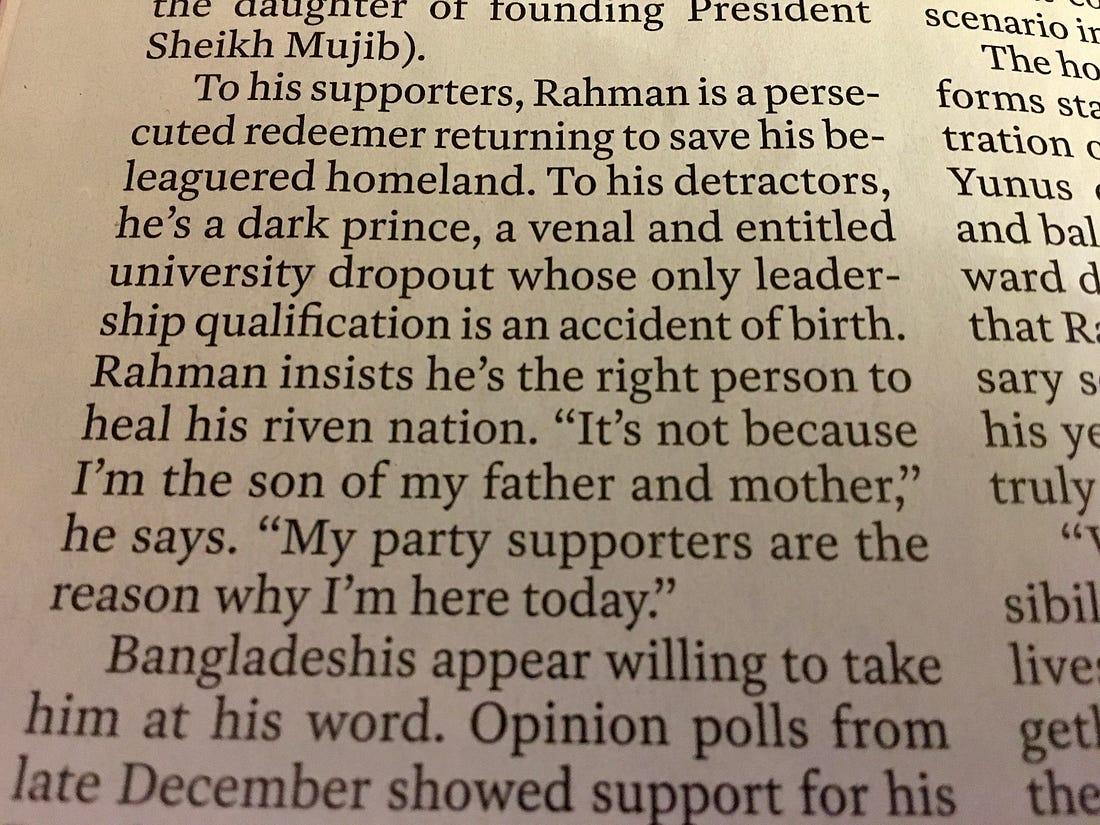
‘Riven’ is a rare word. It’s not a word we hear in everyday conversation. You’re unlikely to hear someone say, “My family is riven,” or “My workplace feels riven.” Yet, when it appears in an article, it carries weight or seriousness. What does it mean? TIME magazine published the article Bangladesh’s Prodigal Son on 9 February 2026 with the sentence: “Rahman insists he’s the right person to heal his riven nation.” It discusses the return of Tarique Rahman to Bangladesh after years of exile to run in the 12 February elections. What does riven mean? Riven is the past participle of the verb to rive, which means to split, tear apart, or violently divide. When something is described as riven, it suggests not just division, but a deep rupture, something pulled apart with force, often leaving scars. Where does the word come from? The word traces back to Old English rifan, meaning to tear apart. It shares roots with words across Germanic languages, all pointing toward acts of splitting or breaking. It suggests something physical, like wood being split along the grain or fabric torn under strain. Unlike more common words such as divided or fractured, riven is about an act of violence, its root, and its aftermath. It doesn’t just describe a state, it hints at the event that caused it and what it leads to. Why does this article use the word riven? Choosing riven instead of divided compresses its meaning: it suggests deep, possibly longstanding, conflict. It evokes emotional and structural damage, and it adds a slightly literary tone, an elevated word, rare but not obscure. In this article, applied to Bangladesh and Tarique Rahman, the word frames the nation as torn in a way that requires healing, and not merely a political rift. What does the article say? Does the sentence match the rest of the article? More specifically, does the content support this level of intensity? The word implies that the article should describe significant political or social divisions, convey tension, conflict, or instability, or position Rahman as a figure claiming to repair these divisions. The article indeed details entrenched political rivalries, polarization, and institutional strain in Bangladesh, so the word riven is not only appropriate, it is precise. It prepares readers for a narrative of fracture and attempted reconciliation. But words like riven are not neutral. They shape perception before we even begin to read the rest of the article. Sometimes, a single uncommon word can carry the emotional thesis of an entire article.
Can’t see the whole article? Want to view the original article? Want to view more articles? Go to Martina’s Substack: The Stories in You and Me More Paris articles are in my Paris website The Paris Residences of James Joyce You're currently a free subscriber to The Stories in You and Me . For the full experience, upgrade your subscription.
|
Wednesday, 8 April 2026
A rare word, but not obscure: the meaning of ‘riven’







Subscribe to:
Post Comments (Atom)

-
petrini1 posted: " For Week 7, the theme of genealogist Amy Johnson Crow...
-
The power pose of personal peace - with psychological benefits ... ͏ ͏ ͏ ͏ ͏ ͏ ͏ ͏ ͏ ͏ ͏ ...
-
A fall, a faceplant, and getting back up again … ͏ ͏ ͏ ͏ ͏ ͏ ͏ ͏ ͏ ͏ ͏ ͏ ͏ ...


No comments:
Post a Comment