
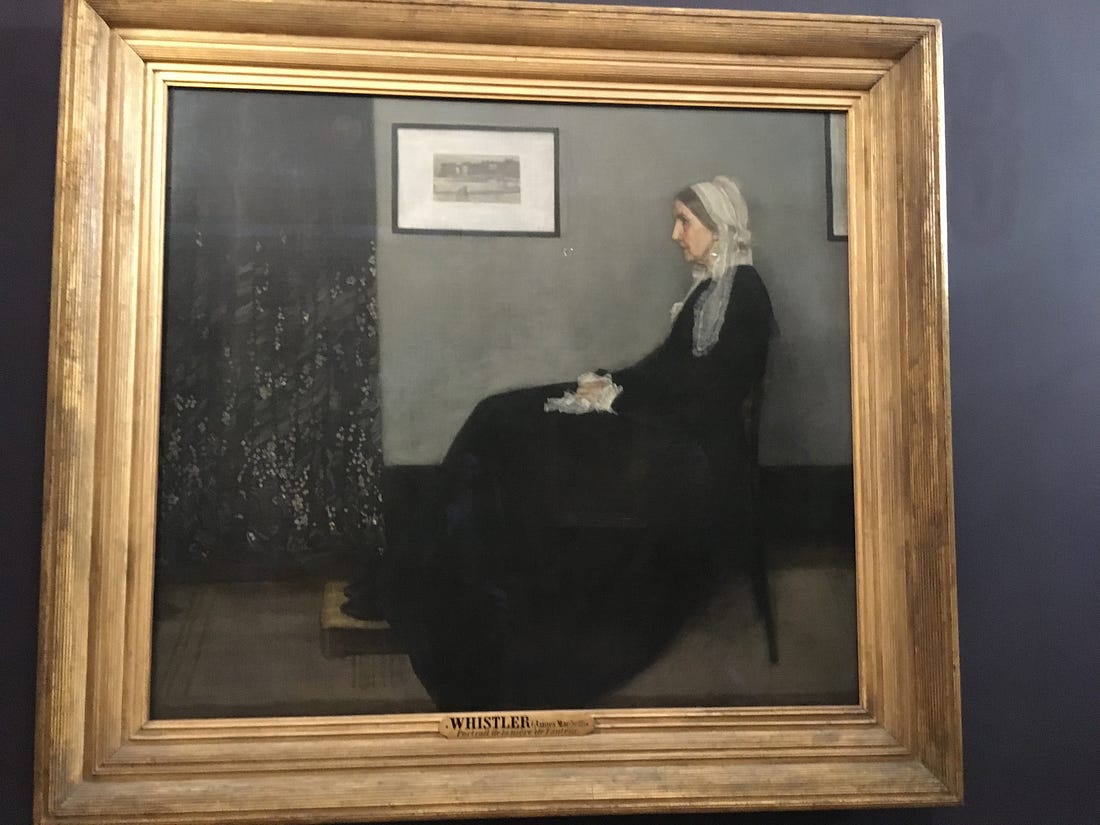
I unexpectedly encountered Whistler’s Mother while visiting the Musée d’Orsay for the luminous Renoir and Love exhibition in April 2026. After rooms filled with sunlight, conversation, and Impressionist joy, I was on an artistic love-high. I turned a corner of the gallery and there she was: seated in silence, dressed in black, composed against a restrained grey interior. The effect was immediate. She was almost impossible to walk away from. James Abbott McNeill Whistler (1834-1903) painted “Arrangement in Grey and Black No. 1” in 1871. It is known as “The Artist’s Mother” and more simply known as “Whistler’s Mother.” The subject is Anna McNeill Whistler. She was around 67 years old when the portrait was painted in London, and he was 37. Whistler was born in America, but spent much of his career in Europe, especially in London and Paris, where he was closely connected to avant-garde artistic circles of the late nineteenth century. What many people may not realize is that this was not originally intended to be a portrait of his mother at all. According to art history accounts, the model that James Whistler planned to use reportedly did not arrive, and his mother, who was visiting James in London, stepped in instead. Because she found it difficult to stand for long periods, he painted her seated. The result became one of the most recognizable paintings in the world. Part of its fame comes from its extraordinary simplicity. The painting is austere, almost minimal: black dress, grey wall, still posture, and no obvious symbolism. Yet it radiates emotional gravity. Audiences saw dignity, restraint, and maternal presence. Whistler preferred harmony, tone, and composition over storytelling. That is why he titled it “Arrangement in Grey and Black No. 1” which emphasizes colour and balance rather than motherhood or portraiture. But, over time, the painting became an almost universal symbol of motherhood itself. What fascinates many visitors is that this quintessentially American image is not housed in the United States, but in Paris. The French state purchased the painting in 1891, making it the first work by an American artist acquired by the French government. That’s remarkable. Today, the work forms part of the permanent collection of the Musée d’Orsay, where it has become one of the museum’s most visited paintings. Standing before the painting in person, right in front of it, eyeball to eyeball, what surprised me most was not the famous image itself, but the atmosphere around it. There is something profoundly modern about the minimalism of it. The empty space matters as much as the figure. The geometry matters as much as the emotion. Look at the curtain, the framed print on the wall, and the severe horizontal line of the floor. Everything is controlled, but not cold. There is still emotion there. I almost cried. There is another layer to the story that makes the work especially moving. Whistler’s relationship with his mother appears to have been deeply influential. Anna McNeill Whistler was religious, disciplined, and emotionally steady. These are qualities almost opposite to the artistic circles that her son inhabited. Whistler did not paint his mother as an idealized Renaissance Madonna, nor as a Victorian madam: not mother, not Madonna, not madam. He painted her with respect. Ironically, the painting’s fame eventually grew beyond the art world entirely. It has been endlessly reproduced, parodied, referenced in films, advertisements, cartoons, postage stamps, and popular culture. But the original, right before me, remains strangely untouched by all that familiarity. Seeing it in person restores its seriousness and also its sensuality. The greys become delicate, the hands become soft, and the artist becomes a patient son in a stark room interpreting his view of his mother. He is totally unaware that the image would one day travel across continents and centuries. After leaving the Musée d’Orsay, I reflected how perfectly Whistler’s Mother complemented the Renoir exhibition I had come to see. Pierre-Auguste Renoir (1841-1910) was only seven years younger than Whistler, so they were in art circles at the same time. Where Whistler stripped away colour, movement, sociability, flirtation, eye contact, intensity of action and sunlight, and everything that Renoir brought to the art world, both painters, in completely different ways, understood intimacy. Renoir found intimacy in cafés, gardens, and human gatherings. The other found it in silence. Further reading : Renoir and the Art of Love and Joy at the Paris exhibition 2026. Can’t see the whole article? Want to view the original article? Want to view more articles? Go to Martina’s Substack: The Stories in You and Me More Paris articles are in my Paris website The Paris Residences of James Joyce You're currently a free subscriber to The Stories in You and Me . For the full experience, upgrade your subscription.
|






No comments:
Post a Comment