Trying to figure out WTF is going on Seamus Logan makes a couple of good points. In his final paragraph he warns pro-independence activists not to "set a political course based solely on what might make us feel good personally". He is right to do so. All too many of the 'cunning plans' swilling around inside the independence movement at the moment are far less about restoring Scotland's independence than about some form of immediate gratification. Not only do they tend to be unrealistic and reckless, their appeal in entirely to other committed activists. They are long on rousing rhetoric and glittering generalities and short on appreciation of the facts of our situation and knowledge of relevant 'real world' rules and procedures. One example would be the 'plan' characterised by the battle-cry to kick the Unionists out of Holyrood by means of some voting strategy which incidentally favours one nominally pro-independence party. While this ploy is sold using the 'independence' tag, it actually has nothing whatever to do with Scotland's cause. A pro-independence Scottish Parliament and Scottish Government are, of course, essential for there to be even the vaguest hope of moves towards independence. This remains true even if the party or parties making up the parliamentary majority and running the administration are no more than nominally pro-independence. Given this, however, the size of the majority makes no difference whatever. There is nothing that can be done by 76 MSPs which cannot be done by sixty-seven. There is no substance to the claim that the so-called 'supermajority' is an independence-related strategy. The undoubted appeal of this and other such system-gaming strategies lies in the equally undoubted gratification to be derived from ousting a few of the British parties' MSPs. The spiel selling this strategy makes great play of pro-independence MSPs vastly outnumbering Unionist MSPs. The rhetoric conceals the fact that - even supposing it is achievable - this huge numerical advantage provides no practical benefit. Both because a majority is a majority and because - as things stand - this would be a 'supermajority' of MSPs from parties which are pro-independence in name only. Parties which lack the wit and the will to progress Scotland's cause. The rhetoric also serves to conceal the partisan electoral benefit that is the real purpose of the 'cunning plan'. It's all about seats, status, salaries, and subsidies. Nothing to do with independence. Independence is reduced to an electioneering device. Despite the uselessness of these voting strategies, they attract a great deal of support simply on account of the personal satisfaction derived from hearing and talking about punishing the British parties and/or one or more of the other nominally pro-independence parties. All part of the toddler-level squabbling which makes such an unedifying spectacle of something that is supposed to be a contest of grand ideas and rooted principles and towering aspirations. Another example of these supposed 'plans' for restoring independence which has that immediate, instinctual, unthinking appeal to pro-independence activists - if nobody else - is the notion of using an election (specifically the 2026 Holyrood election) as a referendum for independence. Which brings us to the second of Seamus Logan's good points. He writes:
He's right! A matter of such magnitude as restoring Scotland's independence cannot be conclusively decided by way of an election pretending to be a referendum. While it may be theoretically or technically possible that independence might be restored by a plebiscite election, politically and practically, it's a non-starter. Not only is a dedicated constitutional referendum the method preferred by the United Nations, but it is also what the public now expect. Public expectation and perception are crucial to democratic legitimacy. Expectation must be met. Perception must be positive. Acceptance of the outcome depends on it. As does the ability to defend the outcome against the inevitable few who refuse to accept it. As to the practicalities of making an election work as a plebiscite, this is a matter that is seldom if ever addressed by those calling for the 2026 election to be used as an independence referendum. The notion appears to be that all that's required is for one or two or maybe three parties to declare that the election is also a referendum, and that's it! I don't think so! But more on that later. Seamus Logan is also spot on when he says that the reaction of the British state to a 'Yes' vote in an election pretending to be a referendum would be casual dismissiveness shading into vitriolic rejection. What Seamus Logan fails to acknowledge is that the parties demanding that the 2026 election be deemed an independence referendum are fully aware that the UK would only recognise a 'No' vote as legitimate and final. That is why you will find carefully concealed in their bold rhetoric about a de facto referendum, a bit which reveals that what they are actually talking about is not a referendum on the question of restoring Scotland's independence, but a referendum on the First Minister making yet another plea for a Section 30 order. There you have the three main reasons a 'plan' to make the 2026 election an independence referendum is an unbelievably bad idea. 1. It is not made clear exactly how an inherently non-binary election could be made to work as a necessarily binary referendum on a matter of such magnitude as breaking the Union. 2. An election pretending to be a referendum would not be accepted as conclusive evidence of the settled will of Scotland's people by the people or the international community and by the UK only if the vote is 'No'. 3. It is not in fact a referendum on independence that is being proposed by the main proponents of the idea, but a vote on whether to request another Section 30 referendum. But it sounds good! It makes for stirring electioneering rhetoric. It's the sort of stuff that gets the crowd roaring and stamping their feet. It's simple enough that anyone can grasp it. Label the election a referendum! Get everybody to vote 'Yes'! Plan your Independence Day celebration! It is politics dumbed down to the level of a TV advert for washing powder. It may not be quite the cheap populism of Donald Trump and his ilk. But it's getting there. In his eagerness to shoot down the idea of the 2026 election being about anything other than a win for his party, Seamus Logan does a decent job of deprecating the de facto referendum idea - despite it having been his own party's policy-like-thing on and off over the years - but doesn't get around to considering the possibility that a way might be found to make the election work as a plebiscite on something other than independence itself but still of importance to Scotland's cause. Of course, the #ScottishUDI plan is probably far too bold and radical for an SNP Member of the British Parliament. But it does both these things, and more. It sets out a practical way of making the 2026 election work as a referendum. And it proposes that this referendum should be on a matter which directly relates to independence without being independence as well as being a matter that promises a more conclusive victory and all but unchallengeable legitimacy. One could be forgiven for supposing the self-styled 'party of independence' would at least take some interest in such a plan. Likewise, others that like to proclaim themselves as pro-independence. But one would be mistaken. What is interesting about Seamus Logan's article is that he was on a train of thought which would surely have brought him to #ScottishUDI, had he not jumped off before the terminus. Invite your friends and earn rewardsIf you enjoy Peter A Bell, share it with your friends and earn rewards when they subscribe.
|
Wednesday, 25 June 2025
Right train! Wrong station!




Tuesday, 24 June 2025
Lies and misinformation
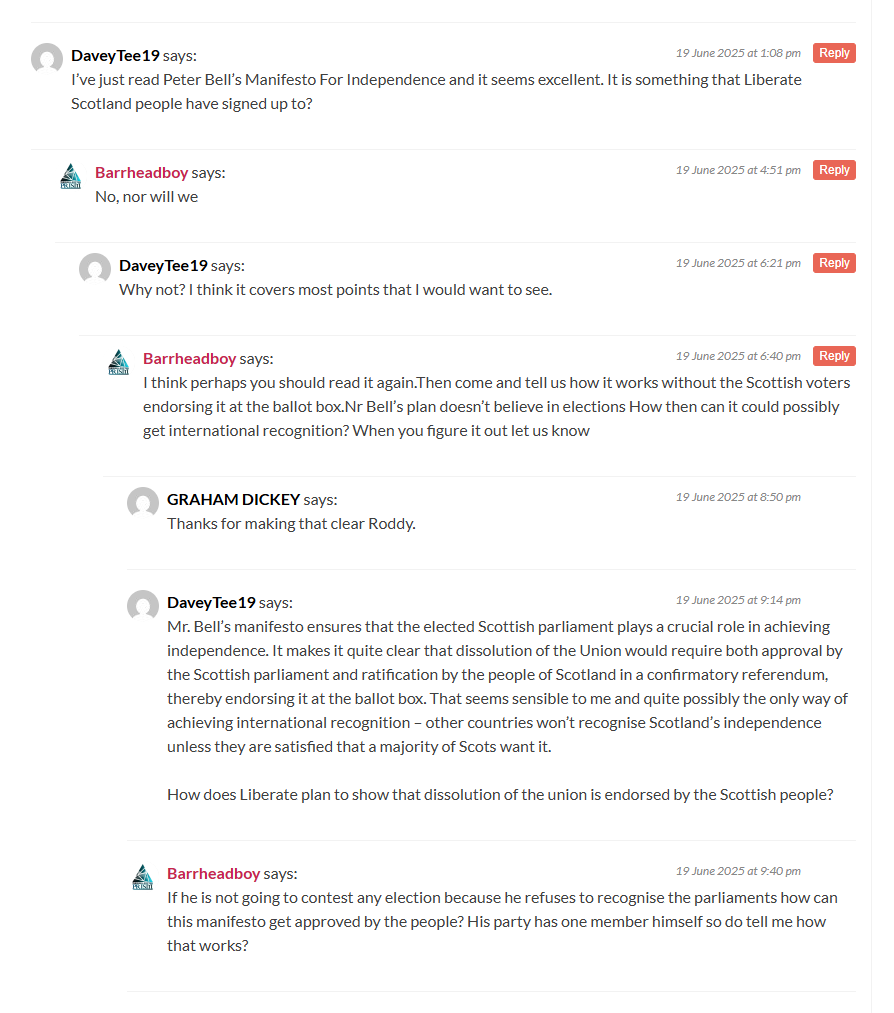
Trying to figure out WTF is going on An exchange in the comments section of the Barrhead Boy blog has been brought to my attention. Normally, I would pay little heed to anything on that site. But there appears to be the beginnings of a campaign of misinformation about the Manifesto for Independence (M4I) and the #ScottishUDI plan which must be countered. Either that or Roddy McLeod, the owner of the blogsite, is an individual who takes some pride in the perfection of his ignorance. Whether the misinformation is being promulgated out of petty maliciousness or simply dumb refusal to inform himself before commenting, nothing that Roddy McLeod says about Manifesto for Independence (M4I) and the #ScottishUDI is true. I'm reluctant to say more because the things he says are so far removed from the facts as to make me wonder if this individual is entirely well. But lies must be shot down and 'misleading' statements must be corrected as they are discovered. Anyone who wants to be correctly informed about anything relating to the Manifesto for Independence should contact myself or one of the members of the working group which is running the Manifesto for Independence Petition campaign. I prefer to be contacted by email at either admin@manifestoforindependence.scot or contact@peterabell.scot. The Manifesto for Independence website is in the process of being rebuilt, but a contact facility and FAQ page will be available soon. Below is a screenshot of the exchange in question followed by my response to the initial comment. I republish it here because I have no confidence that the response will appear on the site. Readers must judge for themselves whether Roddy McLeod is an individual they wish to trust.
A screenshot of the full page can be downloaded here. Firstly, thank you for taking the trouble to read the Manifesto for Independence. Would that others did so before commenting. Your comment and subsequent responses were brought to my attention by someone concerned about the misinformation being spread about the Manifesto for Independence and the #ScottishUDI plan. Whether this is being done purposeful for malicious reasons or out of proud ignorance, I don't know. It is not possible to tell because the result is identical in both cases. The ideal of democracy is that voters should make informed decisions. Those who promulgate falsehoods are enemies of democracy and should be recognised as such. Roddy's replies to you are, to be generous, misleading. He implies that the #ScottishUDI is undemocratic. He says, for example:
As you will be aware having actually read the Manifesto for Independence and supporting information, the process described involves no fewer than three democratic votes. Firstly, there is the election in 2026 of a pro-independence Scottish Parliament with a majority of MSPs having been elected on the basis of personal or party manifestos which include the Manifesto for independence. Secondly, there is the plebiscite part of that election which is made possible by the introduction of a binary element. This is achieved by having all the pro-independence parties stand on election manifestos which incorporate the Manifesto for Independence. This means that every vote for any pro-independence party can be unarguably counted as a vote for the same commitment on the constitutional issue. As a bonus, it also removes party politics from the constitutional issue. It achieves unity of purpose without any need for the parties to come together under a single umbrella group. Which, of course, was never going to happen. The combined election/plebiscite provides a mandate for the Scottish Parliament to assert legislative competence in matters relating to the constitution for the immediate purpose of enabling the exercise by the people of Scotland of our right of self-determination - there being no other way we can do so. The third and arguably most important vote is the confirmatory referendum on an Act of the Scottish Parliament effectively dissolving the Union and establishing a democratic republic of Scotland. The Act itself will take the form of a proposal tabled by the Scottish Government which includes details of how the confirmatory referendum will work and a provisional constitution. Voters will thus know exactly what they are voting for - or against. Anyone who says this process is undemocratic is a liar or a fool or both. You're currently a free subscriber to Peter A Bell. For the full experience, upgrade your subscription.
|
Monday, 23 June 2025
1707! 1999! 2026?
Trying to figure out WTF is going on There are three important dates in the history of the Scottish Parliament. Two are in the past. The third is yet to come. The three years in this timeline are 1707, 1999, and another - which we can only hope will be 2026. Strike that! Hope is not enough! We must act to make the 2026 Scottish general election the democratic event which restores to the Scottish Parliament the status of the national Parliament of Scotland. 1707In 1707 the Scottish Parliament was sold to England and absorbed into the Parliament of England. The intent fully realised in 1707 was to award England a huge and perpetual advantage relative to Scotland. The aim was to make England stronger by making Scotland weaker - and ensuring Scotland was never able to alter that grotesque imbalance of power. In terms of parliamentary powers, this meant the members elected for constituencies in Scotland would always be outnumbered by around ten to one. The parliament of England (plus annexed territories) eventually became the British parliament. The change was cosmetic. It remained the parliament of England, with annexed territories having token representation. This remains the case today. In reality, there is no such thing as a Scottish MP. MPs from Scotland or any part of the periphery can only ever be British MPs - because they are elected to the parliament of England-as-Britain. The longer they sit in the parliament of England-as-Britain, the more they become British MPs. If they achieve high office it is only because they have become British MPs. Contrary to the claim that there have been many Scottish Prime Ministers, there has never been a Prime Minister who was Scottish in any sense other than happening to have been elected in Scotland. They were all British. They would not be there if they weren't. The Scottish Parliament was captured in 1707 and has been held captive ever since. 1999In 1999, after decades of campaigning in Scotland, the British returned the Scottish Parliament. But what they returned was a parliament defanged on a tight leash. It was the Scottish Parliament. But in no sense was it the Parliament of Scotland. What was returned us was a small, thin, deformed husk of the parliament which was taken from us in 1707. It was recognised as the stolen parliament returned by Winnie Ewing, who famously said in her opening address:
The Scottish National Party (SNP), then the unquestioned 'party of independence', also tacitly recognises the 'new' parliament as the 'old' parliament reconvened. The party's constitution states as it's main aim (emphasis added):
The SNP's participation in the devolved parliament implies - at the very least - that this is the parliament to which they want "full powers" restored. The devolved Scottish Parliament is certainly a mere executive arm of Westminster. But only because the colonising power has deemed it so. It is the Parliament of Scotland. But it has been reduced to a subsidiary status by the imposed English doctrine of parliamentary sovereignty - meaning the parliament of England-as-Britain. What we have in the devolved Scottish Parliament is our ancient parliament absent its teeth and securely bound by the Scotland Act. In order to make it once again the national Parliament of Scotland subject only to the sovereign people of Scotland and not some foreign parliament, we must put its teeth back in and break the shackles that hobble it. 2026?The next significant date in the history of the Scottish Parliament will be when we, the people of Scotland, give it back it's teeth and remove the choke-chain held in the grasping hand of jealous Britannia. The next opportunity we have to do this is the Scottish general election in 2026. We can only safely assume that this will be our final opportunity. It would be an amusing understatement to say that it is important we get this right. Restoring "full powers to the Scottish Parliament, so that its authority is limited only by the sovereign power of the people of Scotland to bind it with a written constitution and by such agreements as it may freely enter into with other nations or states or international organisations…" will necessarily and rather obviously require that we break the rules that bind Scotland to England-as-Britain in a manner indistinguishable from the way a colony is bound by the coloniser. We can expect that England-as-Britain will resist. Therefore, we would be wise to consider carefully which rule(s) we break and how we go about it. The most effective way of restoring fangs and freedom to the devolved (constrained) Scottish Parliament is for it to assert legislative competence in matters relating to the constitution. Having powers in relation to the constitution means having powers over everything. Asserting legislative competence in matters relating to the Union is a de facto unilateral declaration of independence (UDI). But stating the immediate purpose of asserting legislative competence as facilitating the free and full exercise of our right of self-determination makes it a human rights issue. By taking the moral and legal high ground of defending a fundamental human right, we make any legal challenge problematic for the British state. It is safe to assume that either there would be no challenge, or that we would win the case. We then proceed to a proper constitutional referendum on a proposal to dissolve the Union and restore Scotland's independence. The most effective way of restoring fangs and freedom to the devolved (constrained) Scottish Parliament is for it to assert legislative competence in matters relating to the constitution. In terms of the history of the Scottish Parliament, it is asserting legislative competence in bold and resolute defiance of the British state that is the significant moment. That is the moment the devolved Scottish Parliament ceases to exist and reverts to being the true national Parliament of Scotland. The parliament of a soon-to-be independent Scotland. But this will not happen unless the independence movement acts to make it happen. We have to be able to demonstrate mass support for a demand that the nominally pro-independence parties commit to specified action within a defined time-frame. If we do not, the next five years will be nothing more than a continuation of the nominally pro-independence MSPs sitting comfortably in the devolved Scottish Parliament still lacking teeth and still tightly leashed. The opportunity will be lost. By taking the moral and legal high ground of defending a fundamental human right, we make any legal challenge problematic for the British state. 2026!If we are to seize the opportunity offered by the 2026 election, we need to be clever, bold, and determined. A bit more clever and a lot more bold and determined than any of the nominally pro-independence parties. It is up to the independence movement to impress on these parties that the 2026 election cannot be a de facto referendum on independence because we cannot sensibly have a referendum on something that cannot be delivered. We have to 'get them telt' that the first thing is to secure a means of exercising our right of self-determination. Be very clear that the issue in 2026 is self-determination and not independence. Be very clear also that these two things are not the same. If we are not clear about this, Scotland's cause loses. We must also teach the nominally pro-independence parties that an election does not become a referendum just because Kenny MacAskill clicks his heels three times saying 'there's no place like Holyrood'. If an inherently non-binary election is to work as a necessarily binary referendum then a binary element must be introduced to the election. The #ScottishUDI plan provides this binary element by the (theoretically) simple device of having all the (former) nominally pro-independence parties adopt an identical commitment to action on the constitutional issue in the first year of the new parliament. Be very clear that the issue in 2026 is self-determination and not independence. When all the pro-independence parties have adopted the same Manifesto for Independence, all votes for any of these parties is demonstrably and unequivocally a vote for that manifesto commitment. Independence ceases to be the electioneering device and party-political football that it has become. Be very clear that the aim of the Manifesto for Independence is to acquire a mandate for the Scottish Parliament to assert the legislative competence needed to legislate for a proper constitutional referendum on a proposal to dissolve the Union and restore Scotland's independence. This is how we make the 2026 election the last to be held for a parliament made less by the British state. Just as Scotland is made less. Just as everyone in Scotland is made less. We will always be less until we take back our government, then take back our parliament so we can take back our nation! You're currently a free subscriber to Peter A Bell. For the full experience, upgrade your subscription.
|

-
petrini1 posted: " For Week 7, the theme of genealogist Amy Johnson Crow...
-
The power pose of personal peace - with psychological benefits ... ͏ ͏ ͏ ͏ ͏ ͏ ͏ ͏ ͏ ͏ ͏ ...
-
… personal protection vs environmental protection – is that the issue? … ͏ ͏ ͏ ͏ ͏ ͏ ͏ ͏ ͏ ...


