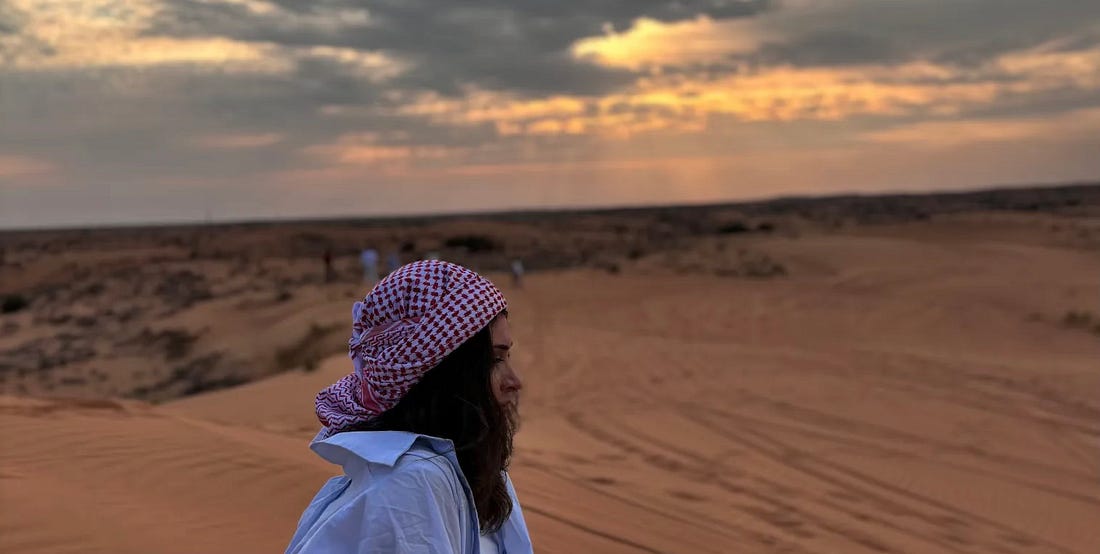
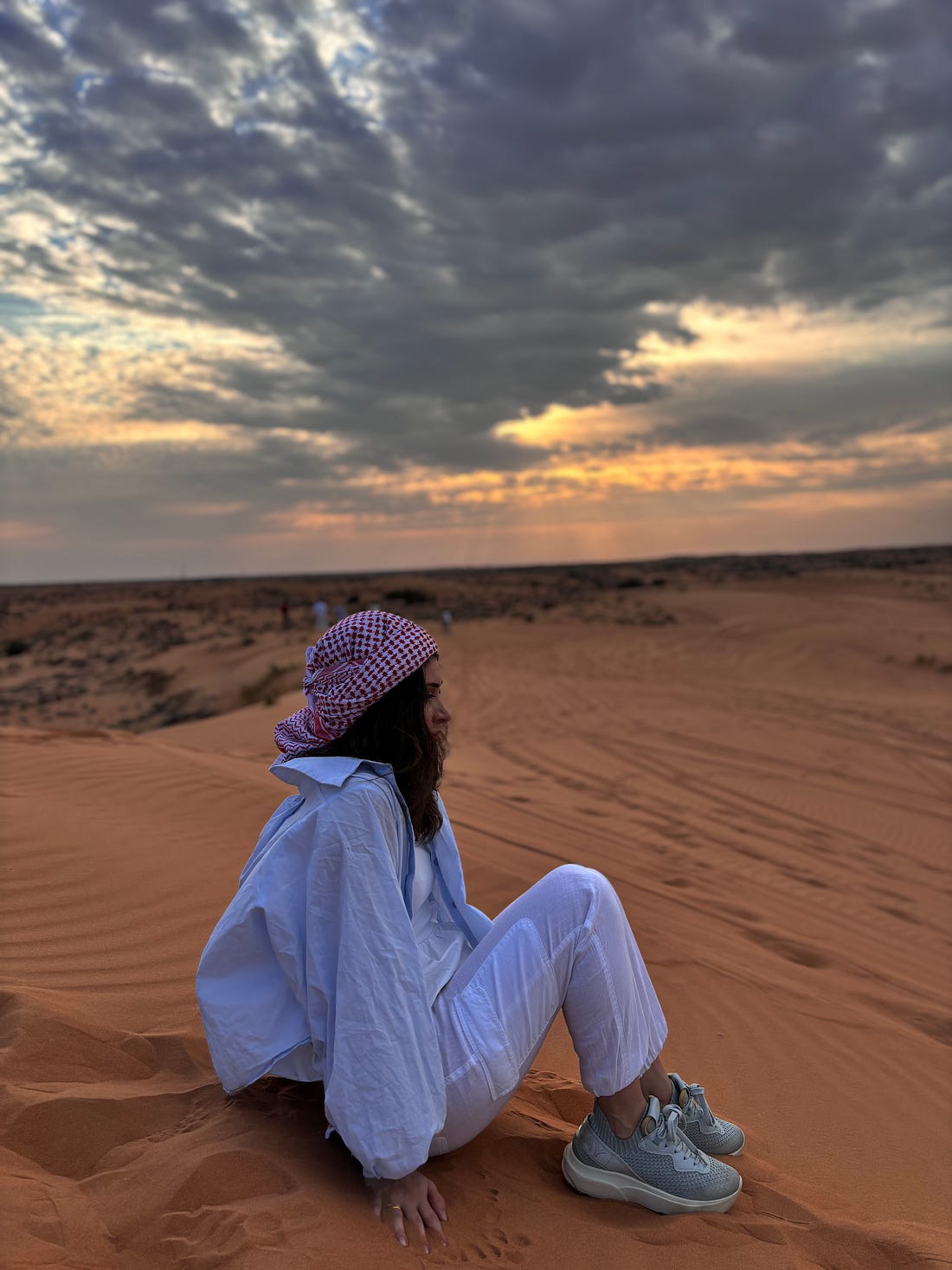
I could write a book from one photograph – this photograph – not because of who is in it, but because it shows a moment and creates a world at the same time: a complete emotional landscape contained within a single frame. Let me try to explain why. The sky is not background. The heavy, textured, almost sculptural clouds press downward, like an architectural ceiling, and yet, there is golden light breaking through. This tension between darkness and light creates the emotional tone of the entire photograph. It feels like a threshold moment, not quite darkness and not quite lightness, not quite despair, and not quite hope. The dune is movement without motion. The sand is alive with wind-drawn lines that are delicate, almost calligraphic. These are not random patterns but directional forces. They guide the eye inward, pulling me toward the subject, the person, then outward again toward the horizon. The indentations, the footprints, the tyre treads, and impressions, show signs that this place has been crossed, traversed, and someone has arrived. And yet, the vastness remains untouched. The figure is still. This is not a person in pose, but a person in a state of being. The body is positioned with extraordinary precision, whether intentional or instinctive: knees drawn but not closed, arms extended but not tense, a hand splayed into the sand is grounding but not holding, and the slight forward angle of the torso is alert, but not defensive. The person is neither resting nor moving. The details that shouldn’t matter, but do: the ring, the shoes without socks, the soft collapse of fabric around the elbows and knees, the structured head scarf, hair loose: always, something loose. These details create contradiction: prepared yet vulnerable, grounded yet transient, present yet elsewhere. The gaze is an unanswered question. Her eyes are not fully seen but their direction is noticed. She is not looking at the camera. She is not looking at the horizon. She is looking at something I cannot access, and that is the masterstroke. I must enter the image to imagine what she is looking at, thinking about, leaving behind, going to next, in solitude, in exile, with the people in the background, with the photographer. This is where the photograph becomes cinematic. It not only looks like a film still, but it also suggests a story before and after the frame. This is where the photograph becomes fundamental storytelling, where everything is in relationship to something else. The sky presses down; the sand stretches outward. The figure anchors the foreground; the horizon frees the distance. The textures of the clouds, the fabric, the sand, collaborate with one another; nothing competes. There is space: space for nothingness but nature, space for emptiness but life, and space for interpretation but meaning. What can I learn about storytelling from this photograph? Mystery is more powerful than clarity. Not everything needs to be explained. This image withholds information, and in doing so, it deepens the mystery. Composition is emotional, not just visual. Lines, textures, and positioning are not aesthetic alone, because they direct what I feel. Stillness can carry more intensity than action. There is no movement yet the photograph is alive with tension and possibility. Details are narrative anchors. A ring, a shoe, and a fold in the fabric are not incidental. They are entry points into a story. A single image can hold an entire book. This may be the most important lesson of all, because when I look at this photograph, I do not see a moment. I see chapters. I see a woman who has travelled, geographically, emotionally, and perhaps spiritually. I see a pause that is not an ending, but a reckoning. I see a landscape that mirrors an internal state. And I realize that storytelling is not about adding more. It is about seeing more. This photograph expands me. It sharpens my perception, deepens my curiosity, and reinforces the point that a story is everywhere, waiting to be noticed. This photograph does that. It does not ask for attention. It earns it. And then, it refuses to let me go. It holds me in so much that I have become obsessed with its potential.
Can’t see the whole article? Want to view the original article? Want to view more articles? Go to Martina’s Substack: The Stories in You and Me More Paris articles are in my Paris website The Paris Residences of James Joyce Invite your friends and earn rewards
If you enjoy The Stories in You and Me , share it with your friends and earn rewards when they subscribe.
|
Monday, 6 April 2026
Storytelling is about seeing more: photo storytelling






Subscribe to:
Post Comments (Atom)

-
petrini1 posted: " For Week 7, the theme of genealogist Amy Johnson Crow...
-
The power pose of personal peace - with psychological benefits ... ͏ ͏ ͏ ͏ ͏ ͏ ͏ ͏ ͏ ͏ ͏ ...


No comments:
Post a Comment