Trying to figure out WTF is going on How many headlines have we seen over the past decade which expressed the same wish as that on Ruth Wishart's column in the Sunday National - Labour’s feeble attempt at inter governmental relations will fuel indy? How often have we been told that this or that development would 'drive voters to Yes'? Why is it always the next straw that's going to be the last straw? Ruth catalogues examples of the British political elite's contempt for the Scottish Parliament through the ages, every one of which was supposedly going to "fuel indy" apparently failing to notice that none of them actually did. What rational reason can there be to "harbour the conviction" that the current 'disrespect agenda' will be different? Ruth herself captures the contradiction.
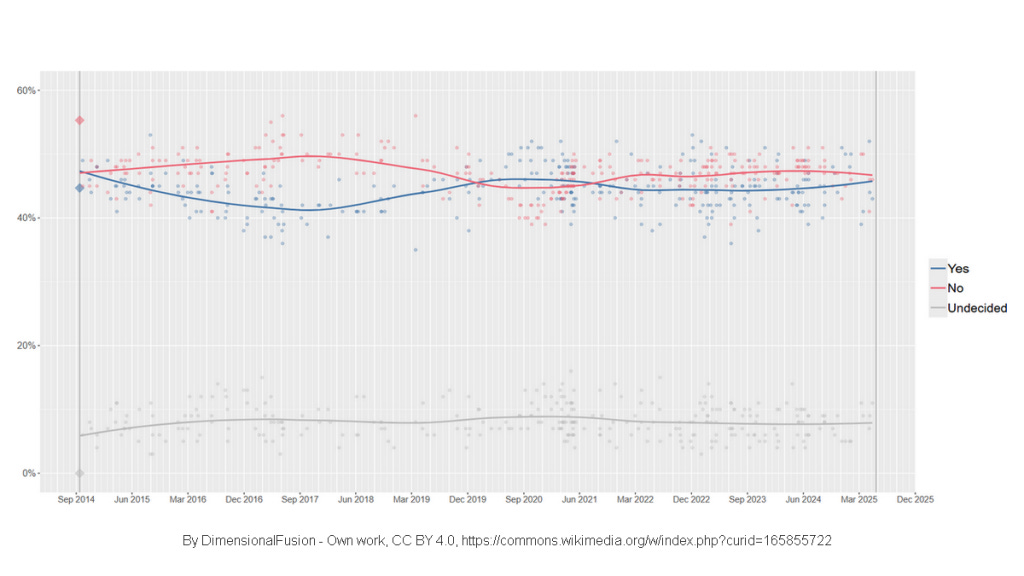
Traditionally, I respond to claims of the British state's "casual insults" to our parliament "having an effect" by sharing the result of a very simple calculation comparing the average score for Yes from a given number of polls immediately subsequent to the 2014 referendum with the average Yes score for the same number of most recent polls. For example, the Yes average for the 12 polls following the 2014 referendum is 45.75%, while the comparable figure for the 12 most recent polls is 46.42%. Effectively, unchanged when margin of error is taken into account. The chart below (courtesy of Wikipedia) is another way of illustrating the unchanging nature of support for independence despite all those instances of the British state demonstrating its lack of any regard for the Scottish Parliament.
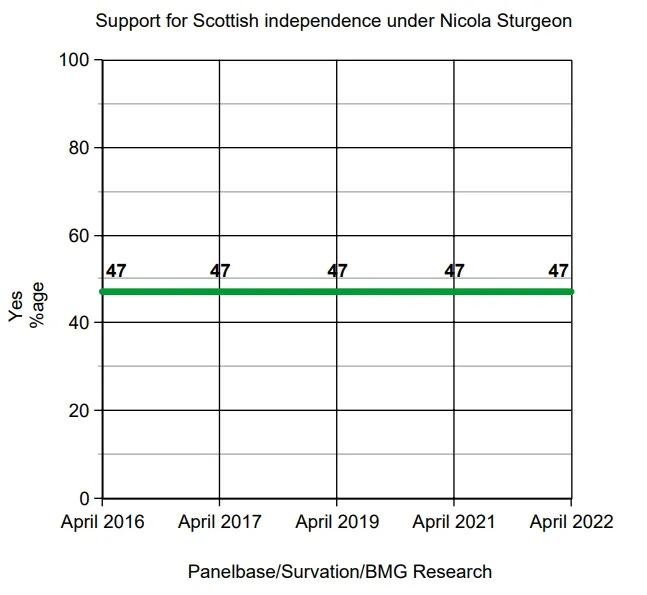
This image from Wings Over Scotland illustrates the point even more starkly.
Despite this hard evidence, Ruth Wishart imagines the sad history of bodies set up to provide for consultation between the British governments and the devolved administrations is going to have the effect that nothing ever has before. Why? It's all just wishful thinking, of course. And it's not only Ruth Wishart who is indulging this folly. It is a distressingly common trait as columnists and commentators strive to energise the independence movement with false hope. Because that seems to be the only kind of hope there is. Ruth opines that we may have become inured to the insults heaped upon us by the 'administering power'. If that is true, then we must have "become immune to insult" long before the modern era of Scotland's liberation struggle, because there is no evidence of it ever having had any impact on polls. Or at least, no sustained effect. Things like Brexit may have caused blips. But these were just little puffs of wind giving the independence sailing ship a tiny and very temporary shove. Not even the aggregate of all those instances of contempt has produced a sustained blast such as might propel Scotland's cause towards our destination. We remain becalmed in the Doldrums of apathy and complacency. As a strategy, wishful thinking has signally failed. Yet is seems to be the only strategy the independence movement knows. There is no appetite for any realistic evaluation of Scotland's situation and the status of our liberation struggle. There is more of an appetite for that cousin to wishful thinking, magical thinking. I've lost count of the number of 'cunning plans' which each have their own set of devotees within the yes movement. For example, the belief that some voting strategy will be transformative. Or the idea that some external agency is going to intervene to the great benefit of Scotland's cause. Or even the belief that we need only 'be positive' and everything will work out. Being positive often seems to be no more than strongly condemning any reference to the reality of our situation. As if assiduously ignoring and concealing the negatives might turn them into positives. This magical thinking has proved no more effective than wishful thinking in progressing Scotland's cause. Which has prompted the thinking part of the independence movement to ask what might work. What could raise a favourable wind to drive the good ship liberation forward? Some of us have concluded that the solution is something truly radical. Given that hoping and pretending have proven useless, maybe we could try telling people the truth about where we are and being honest about what is required to get Scotland's cause out of the Doldrums. Since this is what Ruth Wishart discusses in her column, let's think about the status of the Scottish Government and the Scottish Parliament. Not just what they are, but what we want them to be and what portrayal of these institutions best serves the liberation struggle. Let's not concern ourselves about what the British state says they are, or how the British political elite regards them. After all, that is the status quo. That is what we are seeking to change. In certain parts of the independence movement, it is fashionable to be as dismissive and even as contemptuous of the Scottish Parliament and the Scottish Government as the British are. They are labelled creatures of the British state - the colonial administration. Some self-professed pro-independence activists relish the idea of destroying these institutions. Although it is never explained how we progress Scotland's cause without these democratic instututions or what might replace them or what effect echoing Unionist disdain impacts the campaign to restore Scotland's independence. Of course, they are 'creatures of the British state'. The Scottish Parliament is in law an executive branch of Westminster. The Scottish Government is in reality a colonial administration. It cannot be otherwise so long as Scotland remains a colony. But this is not what we want them to be. if we want independence, this necessarily implies that we want Holyrood to be the national parliament of Scotland. If we want Scotland to be a normal independent nation, it follows that we want a government with the same status as the governments of other normal independent nations. Being independent absolutely requires that ownership of all Scotland's democratic institutions lies with the people of Scotland. The question is, what attitude towards the Scottish Government and Scottish Parliament best serves the process of becoming independent? How do we want the Scottish Government and Scottish Parliament to be perceived by the people we wish to encourage to come out i favour of restoring Scotland's independence. I'm not talking here about converting so-called 'soft Nos'. although Ruth Wishart seems to suppose that is still the mission.
This falls into the same redundant mindset category as wishful/magical thinking. It's the old framing of the issue. The old mindset. The old approach to the constitutional issue that has left Scotland's cause becalmed for more than ten years. The notion that we can have "hard information" about Scotland with independence restored is quite ridiculous. That is a whole new reality. a reality we have yet to experience. Think about the reality we actually have direct experience of. Can we have "hard information" about what this reality will be in ten years’ time? Five years? One year? Realistically, we can have no reliable information about what our lived reality will be a month from now. That lived reality is normally dynamic and presently volatile. If we cannot hope to predict where we will be a few weeks from now based on our experience, how the hell can we hope to have "hard information" about the whole new reality of independent Scotland? Besides, voters don't act on what they know. They act on what they feel. You can feed them all the "hard information" your experts can pull out of their arses and voters will still be led by their gut when it comes time to act. If you want to influence how voters act, don't try to inform them. Provoke them! It is not an appeal to intellect that influences voters no matter how much they wish to be seen as rational. An appeal to emotion is what will get through to them. Forget the old notion of 'soft Nos' who will be triggered by statistics or charts or spreadsheets. The target of our campaign must be the people who don't normally vote at all. Or who have recently disengaged from the democratic process. Our campaign must incite in these people an emotional response that revives their urge to act. We must ask ourselves not what people must be told that will induce them to support restoration of Scotland's independence, but how we must make them feel. The wind that will fill liberation's sails is the blast of righteous anger. Not the swirling storm of rage. The strong, steady breeze of protest against injustice and insult. Anger that is calculating and targeted. Anger that has an outlet in democratic action. The anger that is sparked in people when they are deprived of that to which they are entitle. The anger that is the natural response to being robbed. With an outlet for that anger in acting to restore that entitlement and repossess that which has been stolen. Anger becomes impotent rage in the absence of the power to effect change. What prevents anger running out of control is a clear and credible means of obtaining restitution. It best serves the campaign to restore Scotland's independence if the Scottish Government and Scottish Parliament are perceived by the people of Scotland as rightly belonging to the people of Scotland but 'stolen' by the British state. When they are angry enough about having been robbed, they will be moved to act the get back what is theirs. It is essential that there is a democratic process in place whereby they can take that to which they feel entitled. It makes no sense to dispense with the democratic institutions we have, regardless of how much they are infiltrated and controlled by agents of England-as-Britain - the coloniser. Those institutions are vital for any democratic process by which Scotland will be liberated. If we are to take back our nation, we must first take back our government in order that we can then take back our parliament. The 2026 Scottish Parliament election offers an opportunity for the people of Scotland to assert our authority and take a measure of control over our politics. If we combine in sufficient numbers, we can force the nominally pro-independence parties to commit to specified action on the constitutional issue within the first year of the new parliament. In that sense, we will have taken back our government. It will be doing our bidding. At the same time, we will have initiated the process of taking back our parliament by granting it an undeniable mandate to assert its legislative competence in matters relating to the constitution. That same process will provide us with the opportunity to exercise our right of self-determination in a proper constitutional referendum for the first time in history. Take back our government! You're currently a free subscriber to Peter A Bell. For the full experience, upgrade your subscription.
|
Sunday, 25 May 2025
Stirring the wind







Subscribe to:
Post Comments (Atom)

-
petrini1 posted: " For Week 7, the theme of genealogist Amy Johnson Crow...
-
The power pose of personal peace - with psychological benefits ... ͏ ͏ ͏ ͏ ͏ ͏ ͏ ͏ ͏ ͏ ͏ ...
-
A fall, a faceplant, and getting back up again … ͏ ͏ ͏ ͏ ͏ ͏ ͏ ͏ ͏ ͏ ͏ ͏ ͏ ...


No comments:
Post a Comment