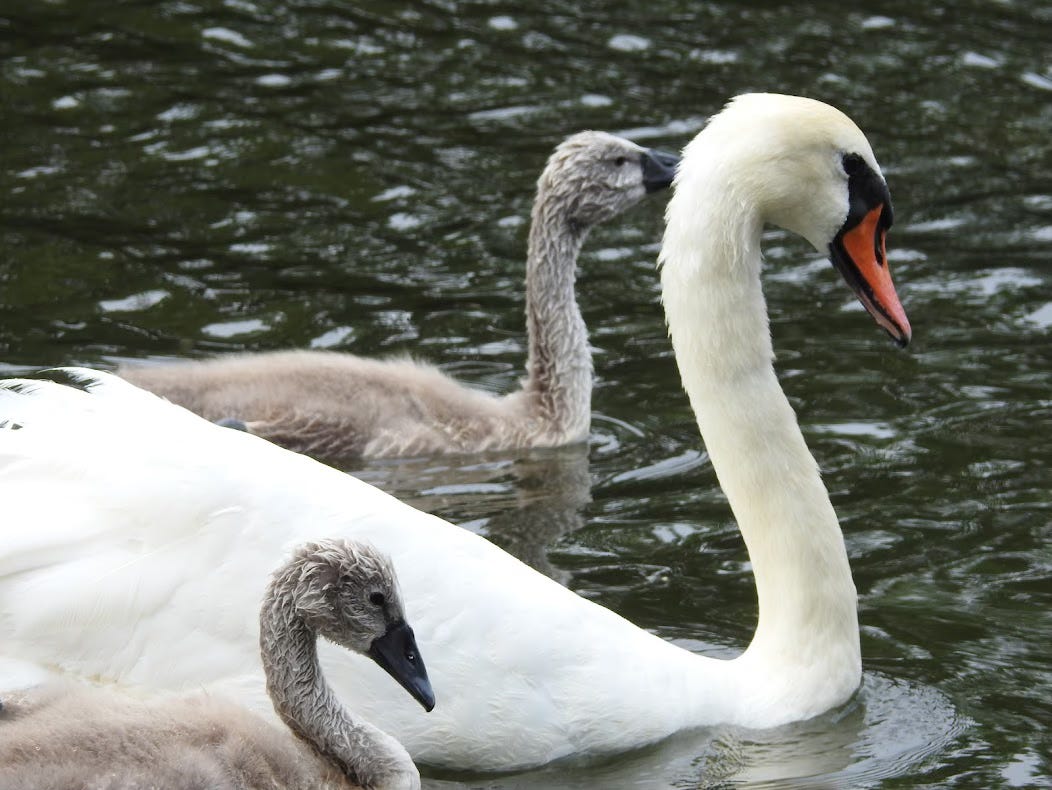
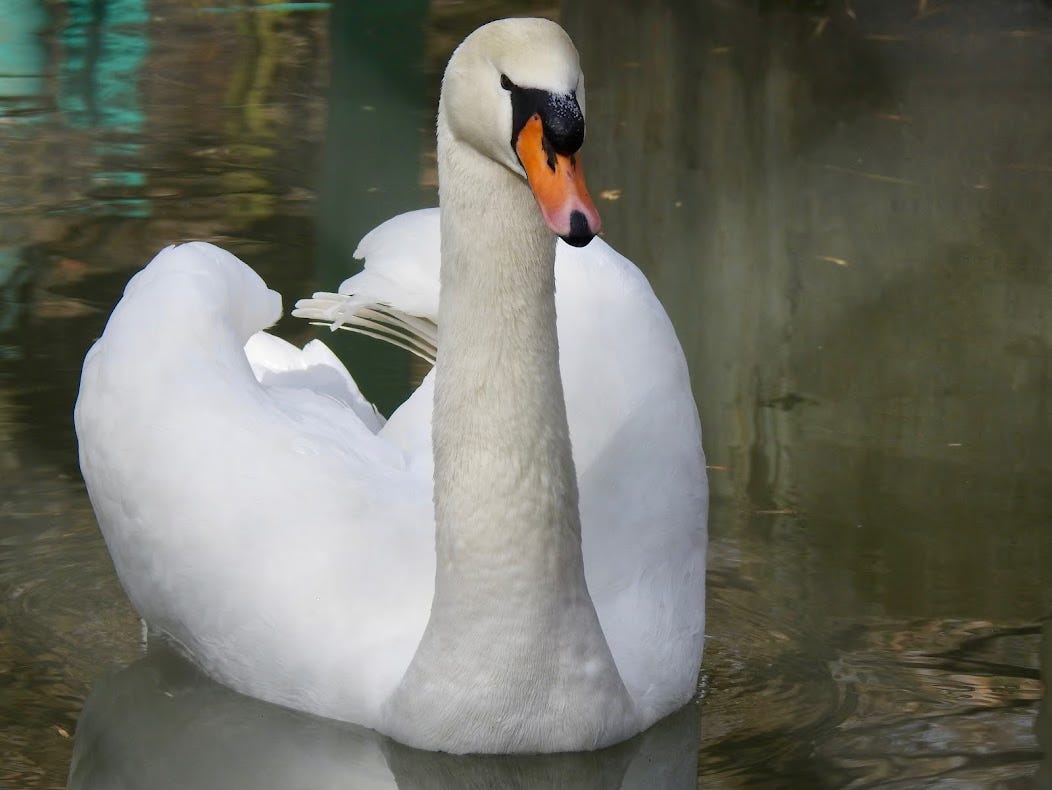
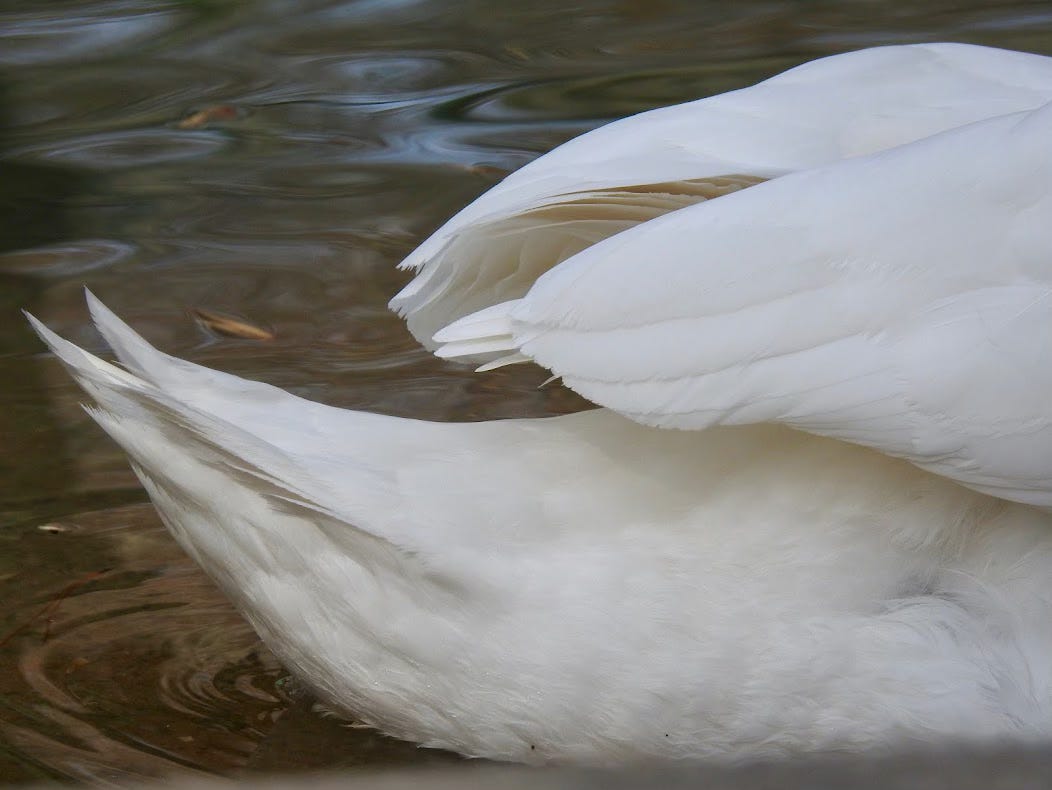
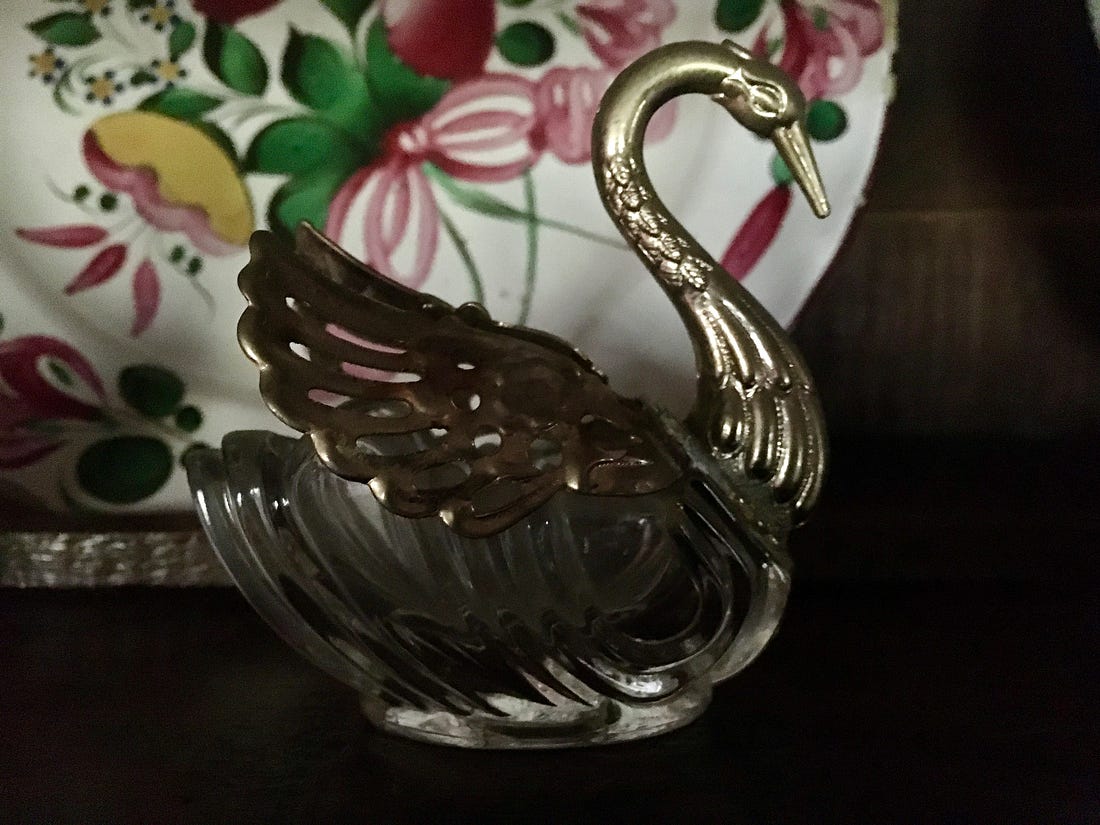
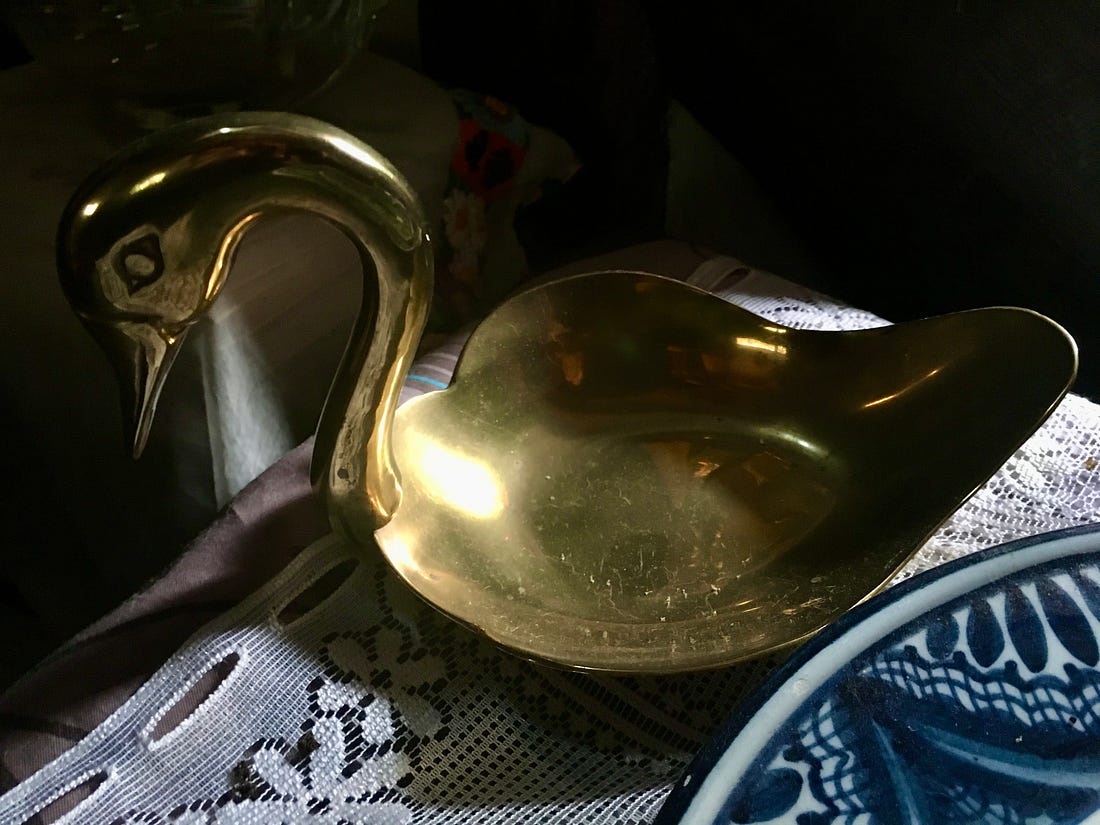
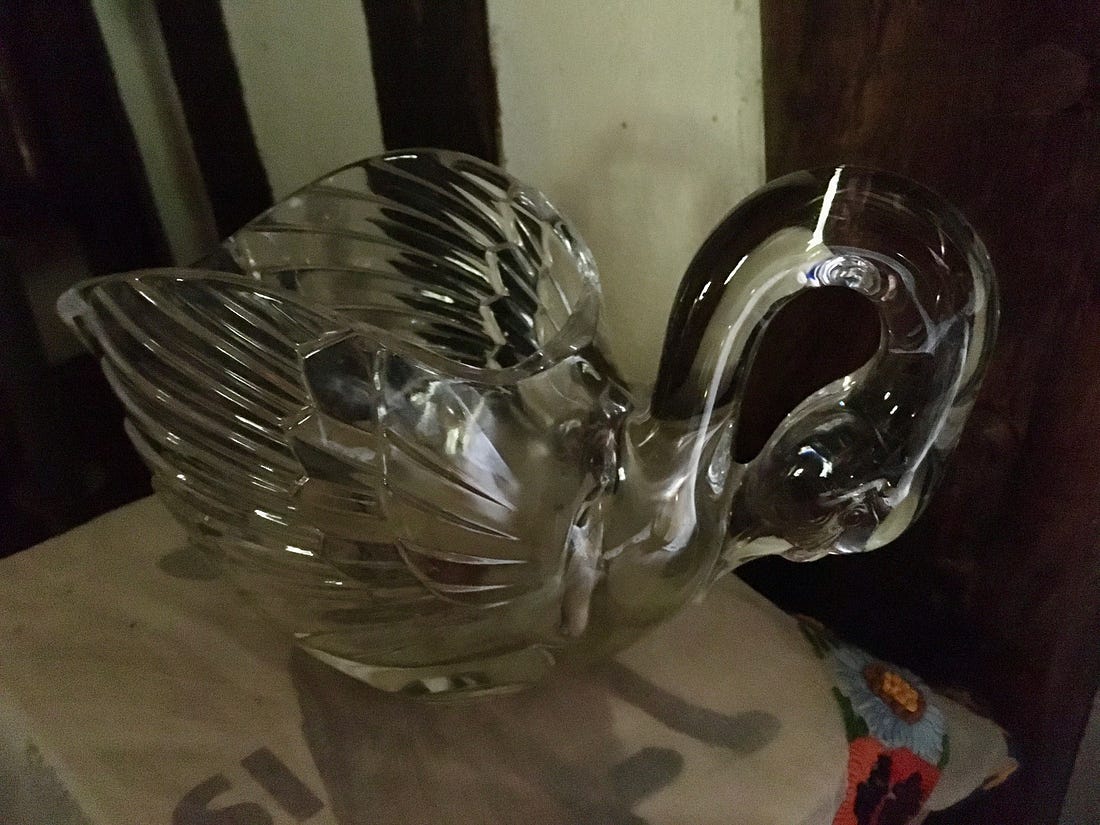
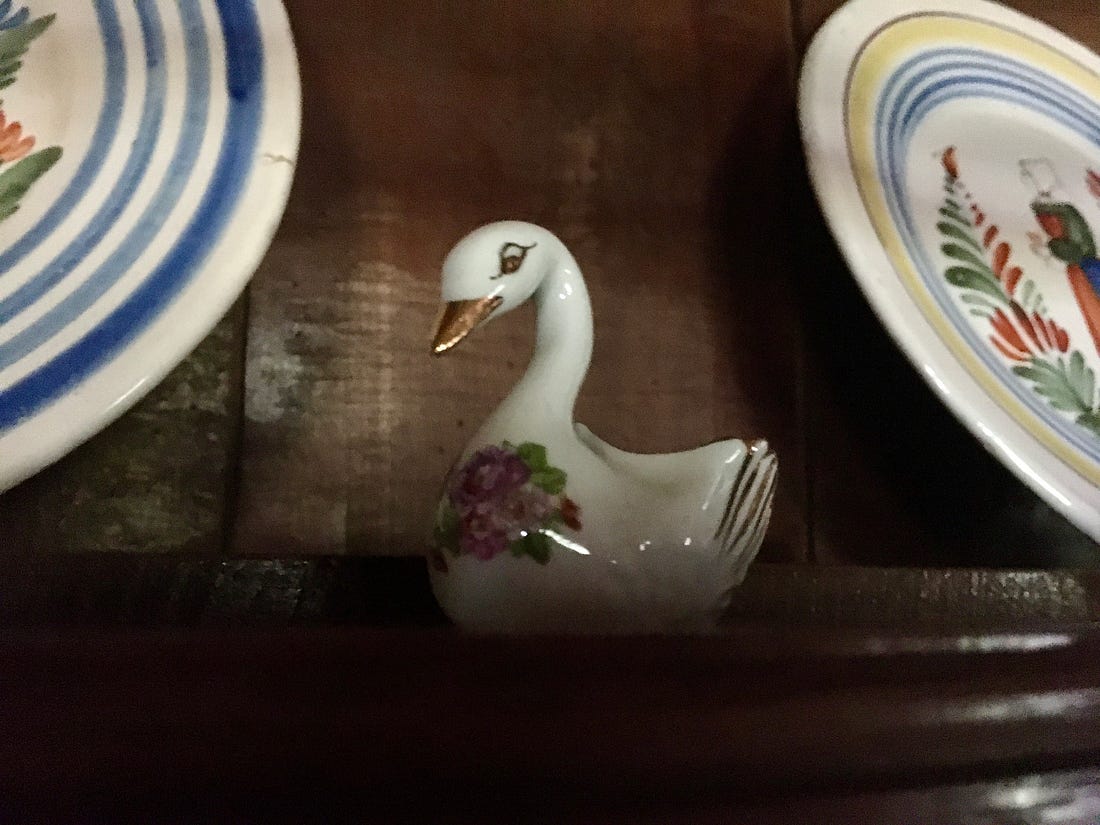
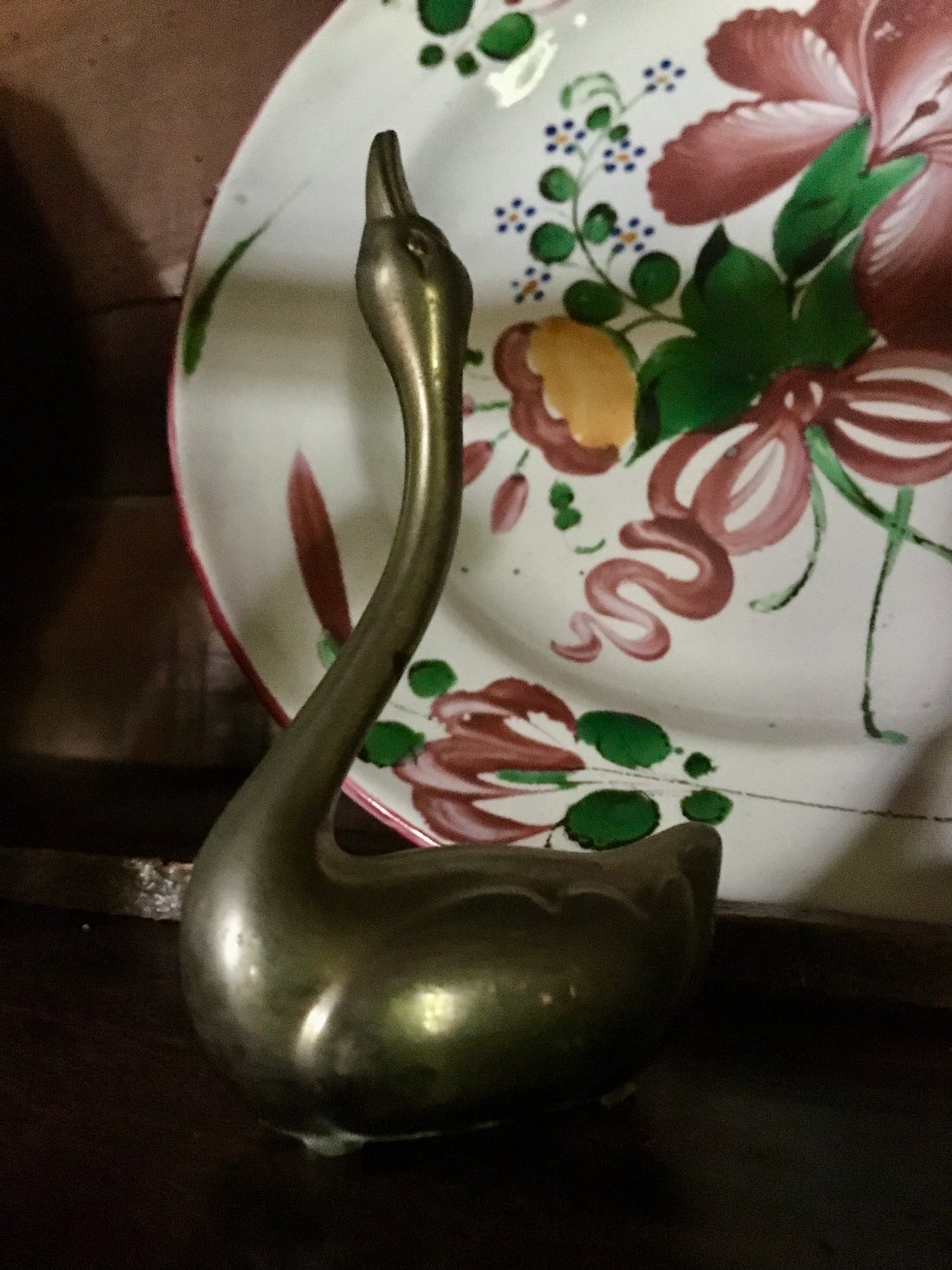
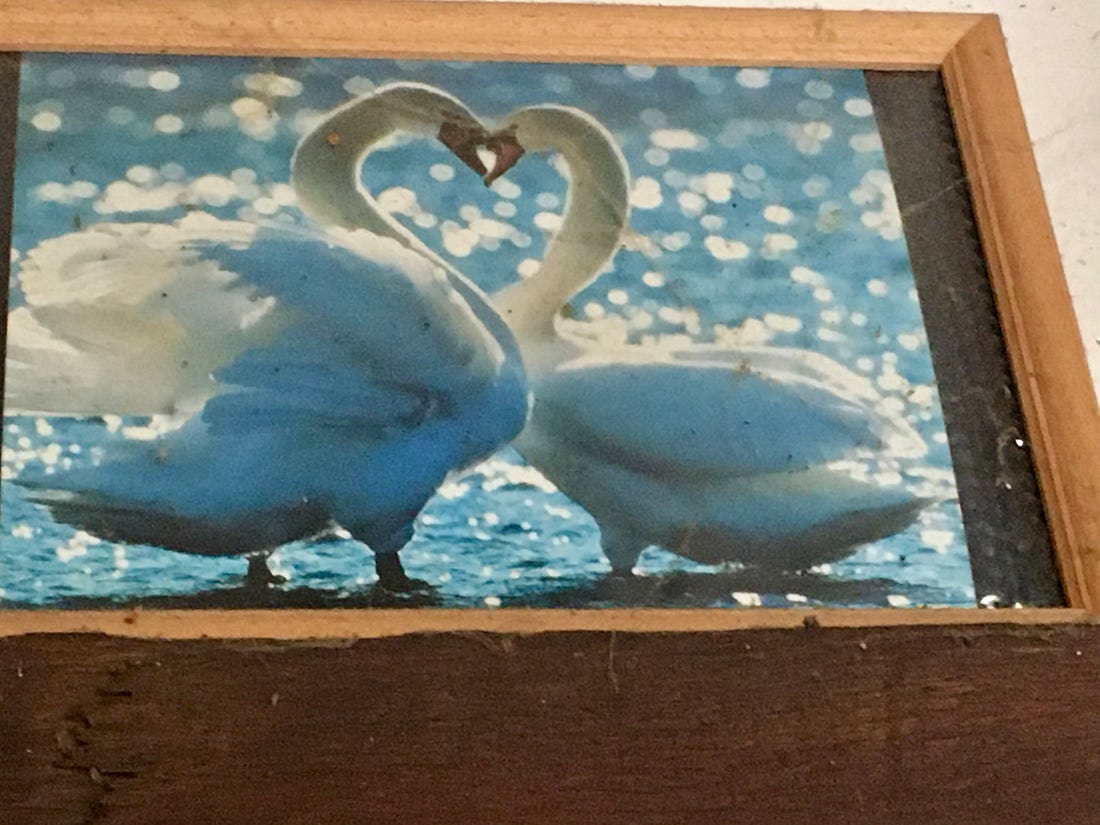
Swans are both emblematic and ominous in France. Aunt Jeanne in Normandy keeps a small shrine to them: postcards, photos, frames, embroidery, quilts, porcelain, glass, pewter, and copper in every nook and cranny around her French cottage. I’m swanning around the French cottage with all eyes on me and my ungainliness. Swans are large and white, except for the slate-grey youngsters that haven’t got their adult feathers yet. The most familiar in France is the Mute Swan (Cygnus olor), seen in canals, parks, and gardens. They signify fidelity, constancy, and devotion: pairing for life, they re-pair only if a mate is lost, returning to the same part of the river each spring, and their curved necks forming a heart shape when they connect beak to beak. In heraldry and folklore, the “Swan Knight” legend in medieval France signifies water, watchfulness, and purity. Normandy is swan country. Aunt Jeanne’s marshy corner of her property, a side channel off a farm road, ringed with alder and nettle, attracts ducks and swans. To her, they are good for the land. What Aunt Jeanne taught me (that field guides don’t) is that Mute Swans have much to say. She says “she waters the garden and the swans garden the water.” A pair of swans will clear choked ponds of debris by tugging up submerged plants and pruning the shallows into neat lawns to improve the water quality. They use their necks like oars to swim underwater where they pluck plants from the bottom of the pond. She describes a swan’s nest as architecture, not a heap of grasses. From March, swans pile together reeds, bulrushes, and grasses to form a platform nest that could be spotted from her country lane. The female (pen) lines the nest with down and the male (cob) stands guard. She confirms that mute does not mean completely quiet, nor harmless. A nesting cob will charge at anything too close to the nest: dogs, foxes, and even tractors – without honking. But overhead, she says “you can hear swans coming because they fly like arrows.” Mute Swans in flight make a thrumming sound as their wings beat, and they are not speechless as they emit soft hisses. She cautions that “the French love their bread but bread bloats the swans.” Like many waterbirds, swans feed on aquatic plants or small grains. Old bread can bloat them and foul the water. She says “swans see you seeing them.” Swans have keen vision and a sense of the dramatic, especially when protecting their young. Their eyes watch everyone Swans are a paradox: massive yet mesmerizingly graceful, quiet yet fiercely protective, aloof yet lovingly loyal. In France, they are proof that any bend of a river can turn majestic when a white swan drifts into view. As the lead singer Marc Bolan of T. Rex sang in his 1972 song “Ride a White Swan”: Wear a tall hat like a druid in the old days
Can’t see the whole article? Want to view the original article? Want to view more articles? Go to Martina’s Substack: The Stories in You and Me More Paris articles are in my Paris website The Paris Residences of James Joyce Rainy Day Healing - gaining ground in life You're currently a free subscriber to The Stories in You and Me . For the full experience, upgrade your subscription.
|
Sunday, 17 August 2025
Swanning around a French cottage in Normandy






Subscribe to:
Post Comments (Atom)

-
petrini1 posted: " For Week 7, the theme of genealogist Amy Johnson Crow...
-
A fall, a faceplant, and getting back up again … ͏ ͏ ͏ ͏ ͏ ͏ ͏ ͏ ͏ ͏ ͏ ͏ ͏ ...
-
The power pose of personal peace - with psychological benefits ... ͏ ͏ ͏ ͏ ͏ ͏ ͏ ͏ ͏ ͏ ͏ ...


No comments:
Post a Comment