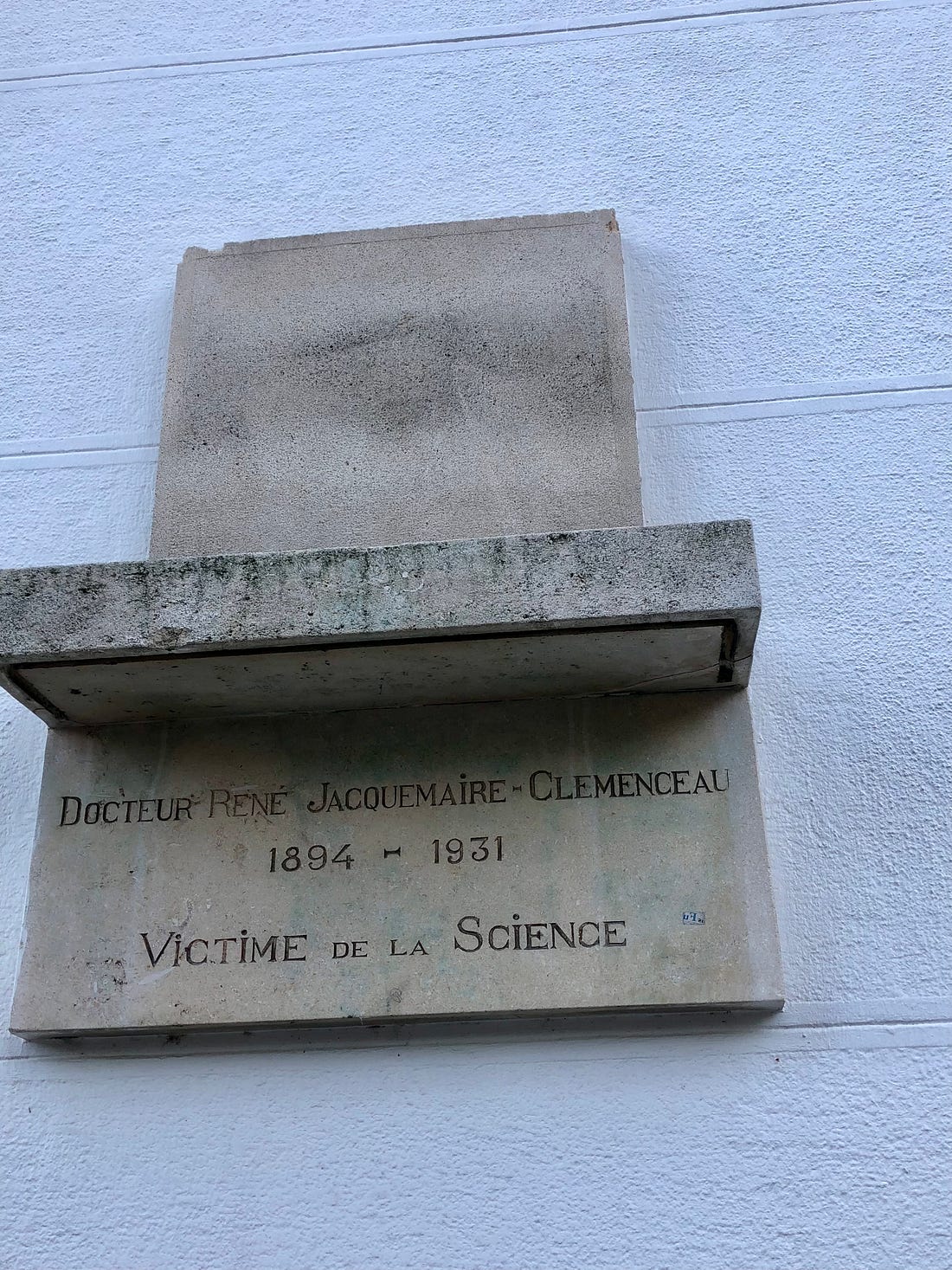
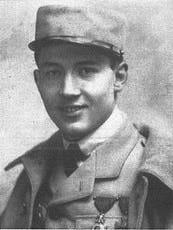
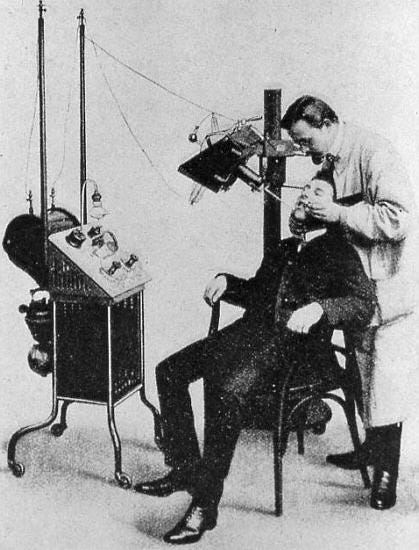
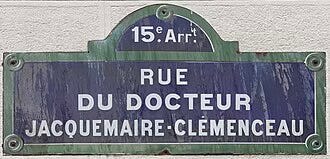
Little is known of the French doctor who pioneered radiology and died because of it. Scientists Pierre and Marie Curie discovered radium in 1898 and researched its medical applications for treating cancer with X-ray. The negative consequences of working unprotected long-term with radium was not fully known at the time. Pierre died in 1906 after being struck by a horse-drawn carriage and Marie continued their research in the Radium Institute, specifically built for her by the University of Paris and the Pasteur Institute from 1909-1914. She worked in the laboratory until her death in 1934 at the age of 66 from aplastic anemia due to her long exposure to radium. I’ve visited the Radium Institute in Paris several times, where her original 1902 paper, noting the mathematical calculations to determine radium’s atomic mass, is still radioactive to this day. At the same time, René Jacquemaire-Clemenceau, was pioneering radiology too, although I can find no evidence that he worked with Marie Curie. Regularly, I pass a building stone engraved with his name, stating that he was a “victim of science.” The stone was erected in 1932, along with a memorial bust, which is now missing. It is a powerful statement because it honours the man and the cost of progress. Born on 14 October 1894 in Paris, Georges Ernest Numa René Jacquemaire-Clemenceau died on 10 July 1931 at the age of 36, a victim of excessive and prolonged exposure to X-rays and radium. While sources detailing his work are a little thin, we know that he was regarded as “un des promoteurs de la radiologie en France” (“one of the promoters of radiology in France”). The phrase “victim of science” is not a poetic exaggeration but quite literal. He was a physician who, in the pursuit of advancing medical science using X-rays, became one of radiology’s early casualties. X-rays were still relatively new after their discovery in 1895 by Wilhelm Rontgen and Jacquemaire-Clemenceau’s work was at an important junction: radiology moving from novelty to standard medical practice, the rise of technicians in radiology, and the gradually emerging awareness of radiological risks. In a sense, when he died, France lost a young doctor, but recognized that “exposure” is not just about benefit, but about risk. René Jacquemaire-Clemenceau’s life may not be celebrated today, but he represents the optimism and ambition of medicine in the early 20th century. On the one hand, he was using a new invisible ray to “see” inside the body, to diagnose, and to help determine a treatment. On the other hand, his fate shows how rapidly new innovations, without knowledge and protection, can become a double-edged sword.
Can’t see the whole article? Want to view the original article? Want to view more articles? Go to Martina’s Substack: The Stories in You and Me More Paris articles are in my Paris website The Paris Residences of James Joyce Rainy Day Healing - gaining ground in life You're currently a free subscriber to The Stories in You and Me . For the full experience, upgrade your subscription.
|
Sunday, 19 October 2025
Victim of Science: René Jacquemaire-Clemenceau






Subscribe to:
Post Comments (Atom)

-
petrini1 posted: " For Week 7, the theme of genealogist Amy Johnson Crow...
-
A fall, a faceplant, and getting back up again … ͏ ͏ ͏ ͏ ͏ ͏ ͏ ͏ ͏ ͏ ͏ ͏ ͏ ...
-
The power pose of personal peace - with psychological benefits ... ͏ ͏ ͏ ͏ ͏ ͏ ͏ ͏ ͏ ͏ ͏ ...


No comments:
Post a Comment