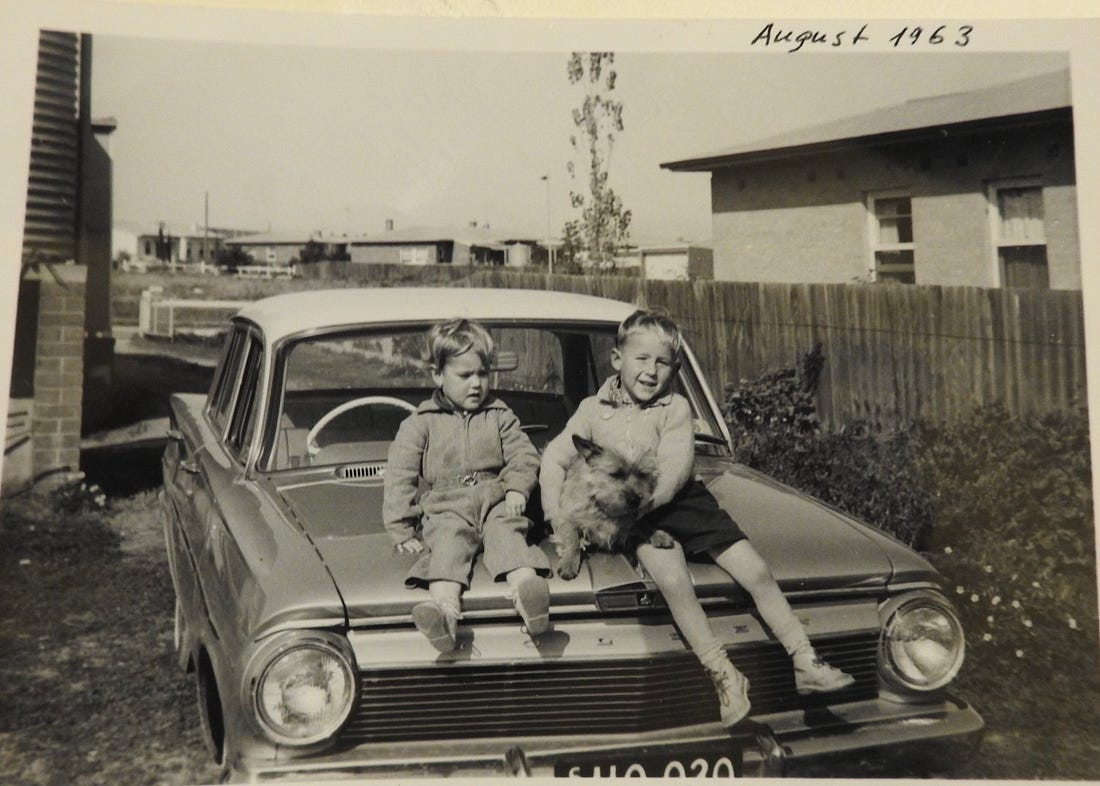
It is August 1963. Two kids are perched on the bonnet of a Holden, grinning at the camera like they’ve just conquered the Outback. That’s my brother and sister, in Australia, their legs dangling, shoes scuffed, with our dog sitting between them. The photo is black and white, but I can still see the color of that summer in my mind: a sunburnt lawn and the endless blue sky that stretched over every childhood in Australia. Our home is in a new town in South Australia, 25 kilometres (15 miles) north of Adelaide. It was established in 1955 out of dry farming lands and eight years later, it was still new and growing. We didn’t need a playground. Our playground had chrome bumpers and vinyl seats that baked in the heat. Cars were freedom, whether they moved or not. Cars were adventures before the journey even began. There was something magical about being in the car, on the car, or by the car, even when it wasn’t moving. The tick of the cooling engine, the long, satisfying clunk when the door closed. We could sit there for hours imagining we were driving across the Nullarbor Plain or escaping bushrangers in the Outback. Back then, roads weren’t just routes and cars weren’t just transportation. They were possibilities and dreams on wheels. The hum of the engine meant a Sunday drive to the beach or a visit to relatives. For kids, cars were miniature worlds: back seats became forts, castles, pirate ships, and rocket launchers. The steering wheel was a spaceship control panel. Life was slower then. Life was spent outdoors. Parents didn’t track us on phones because phones had dials and not GPS. There were no seat belts. We rode our bikes without helmets, and when we weren’t riding, we were sitting on the bonnets of Holdens, talking about what we’d do when we grew up (which seemed so far away it might as well have been the moon). Cars were dreams wheels and steel: shiny and solid. We didn’t own many things as a kid, but for those afternoons when we leaned back against the warm bonnet and looked at the wide Australian sky, we felt like we owned the world. Looking back now, it’s not just the cars we miss; it’s what they symbolized. They represented the simple thrill of movement, a time of shared journeys, and the sense that the open road was freedom and adventure.
MY PARIS WEBSITE AND ALL THINGS PARISIAN Photographer: Martina Nicolls PIP DECKS, the fun and engaging how-to guides for business. LATEST BOOK: INNOVATION WITHIN CONSTRAINTS HANDBOOK BOOK REVIEW 8 March 2025 – Yelyzareta Packed with Real-World Case Studies!This book delivers exactly what it promises—practical, actionable insights on innovation within constraints. I was impressed by how many case studies are included, all presented in a concise yet impactful way. While studying for my MBA in Innovation Management, I’ve come across many resources, but this one stands out for its clarity and depth. It’s not just theory—it’s a collection of real examples that prove innovation thrives even with limited resources. A must-read for anyone serious about problem-solving and creative thinking!
You're currently a free subscriber to The Stories in You and Me . For the full experience, upgrade your subscription.
|
Sunday, 12 October 2025
When cars were dreams on wheels









Subscribe to:
Post Comments (Atom)

-
petrini1 posted: " For Week 7, the theme of genealogist Amy Johnson Crow...
-
A fall, a faceplant, and getting back up again … ͏ ͏ ͏ ͏ ͏ ͏ ͏ ͏ ͏ ͏ ͏ ͏ ͏ ...
-
The power pose of personal peace - with psychological benefits ... ͏ ͏ ͏ ͏ ͏ ͏ ͏ ͏ ͏ ͏ ͏ ...


No comments:
Post a Comment