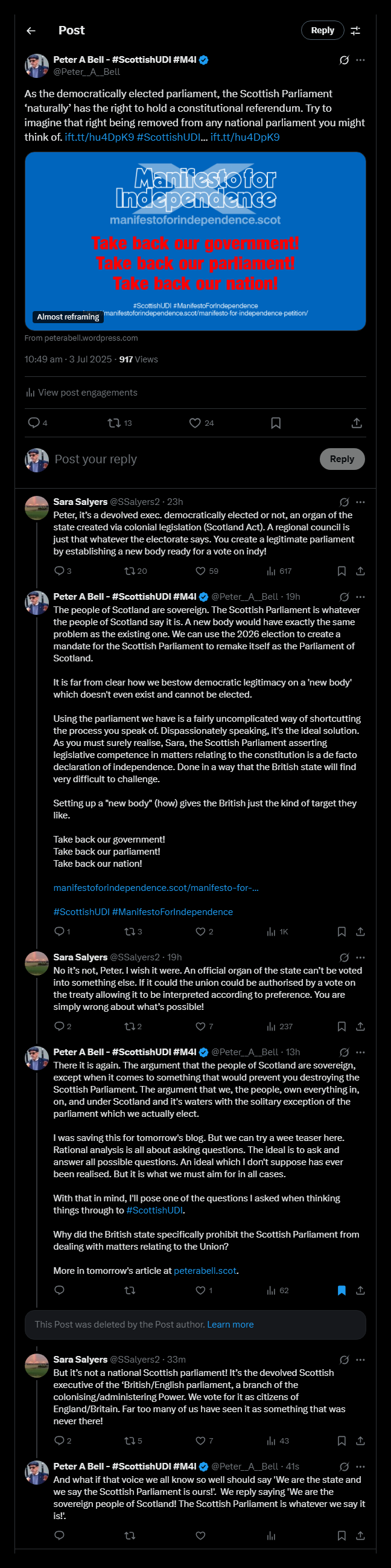
Trying to figure out WTF is going on As I said to someone on X just a short time ago, the way #ScottishUDI and the Salvo/Liberation UN initiative fit together is positively elegant. The former provides the essential internal (to Scotland) political and parliamentary process which is perfectly complemented by the latter. Meanwhile, should the Manifesto for Independence achieve significant support, it will create a very visible demonstration of the demand for independence. At least as importantly, it will demonstrate that we are putting in the effort ourselves in a way that can directly exploit UN recognition of Scotland's status as annexed territory. The victim of colonisation thinly veiled by a fake political union. Given that the two efforts work so well together, it is unfortunate that I find myself in such strong disagreement with Sara Salyers, one of the main architects of the UN initiative, on a point of considerable importance. The image below is a screenshot of a recent exchange on X which nicely illustrates the conflicting perspectives on the Scottish Parliament. [It appears that some of Sara's comments have since been removed. I make no comment other than to state that the screenshot is genuine.] It is an exchange which has been repeated almost verbatim a number of times. Neither of us is moving on this matter.
I can't move because for me, the sovereignty of Scotland's people is a red line that can barely be approached, far less crossed. I cannot speak for Sara, of course, but it appears to me that she is not moving because the law is her red line. She will, I'm sure, correct me if I have got that wrong and she has some other reason for insisting that the sovereignty of the Scottish people does not extend to the parliament directly and democratically elected by Scotland's people. My position is that the Scottish Parliament is, if you like, the 'real' parliament of Scotland. It is our national parliament. It has an impeccable claim to this status by virtue of the fact that it is mandated by the people of Scotland in an entirely democratic process which ensures proportional representation. It is as Winnie Ewing said as she chaired the first meeting of the Scottish Parliament on 12 May 1999.
Again, I do not presume to speak for Sara, but her own comments in that social media exchange make it clear that she considers the Scottish Parliament to be the 'property' of the coloniser in perpetuity and quite regardless of the will of Scotland's people. The fact that it has all the democratic legitimacy of a national parliament is not something Sara considers relevant. It is a creature of the British state and nothing - absolutely nothing! - can change that. On the fact that the Scottish Parliament currently functions as an executive branch of Westminster, Sara Salyers and I are in total agreement. Where we differ is in regard to how it came to be thus. Whereas Sara insists that because it was made thus by the very colonialist power whose authority we both intend to deny in relation to all else in Scotland, it cannot be other than what the British state says it is. Specifically, it cannot be the national parliament of Scotland once independence is restored. PrecedentSara is fond of citing precedent and referring to the way it was done when other annexed territories became independent. I intended to argue that there is precedent for legislatures established during the period of colonisation continuing as or transitioning into the post-independence parliament. I had in mind the example I favour as it bears the closest parallels to Scotland's situation, Norway. But I was pretty sure there were at least one or two examples among former British colonies. I decided to check, as much to satisfy my own curiosity as to counter the assertion that a pre-independence legislature cannot be the post-independence parliament. I put the question to Google's Gemini Advanced AI. (I got a year's subscription free with my Chromebook and I'm determined to use it.) The question I asked was:
Gemini AI's response was so interesting I've decided to publish it in full here.
The short answer to my question about which former British colonies had a parliament prior to independence which continued after independence is, pretty much all of them. Plenty of precedent there for the Scottish Parliament being the national parliament of independent Scotland. My contention is that the Scottish Parliament is (or should be regarded as) the original Scottish parliament restored to Scotland by the coloniser under pressure from the nationalist movement in the annexed territory, but returned in chains. It should be seen as the national parliament of Scotland which has been commandeered by the British state. All that is required to make it once again the parliament that Winnie Ewing reconvened is removal of the chains in which the British returned it to us. #ScottishUDI is the plan to break those chains. Divergent analysesThe fact that Sara Salyers and I have come to such different conclusions about the nature and status and potential of the Scottish Parliament suggests that our analyses of the situation have diverged markedly. Sara is a lawyer, of course. I am not. Which is not to say I'm ignorant of the law. Especially when it relates to the constitutional issue, I make a point of familiarising myself with the relevant legislation. While I am mindful of the applicable law, I come at the issue more from the political angle. I analyse it not as a matter of law, but as principally a political matter. Analysis involves the asking of questions. The worth of any analysis derives not from the accuracy of the answers but from the perspicacity of the questions. With this in mind, the original purpose of this article was to share with readers the type of questions I might ask when analysing the matter at hand - the status etc. of the Scottish Parliament. The hope is that this will provide some insight to the reasons for me concluding that we should treat the Scottish Parliament as the true parliament of Scotland that has been stolen from us and put into service by the coloniser. As we saw earlier, it has happened before. I don't know how Sara approaches these things. I have no idea what questions she asks. Let's start with some I'm fairly sure she didn't ask.
OK! The first on the list is actually two questions. But they are so closely related that I reckon we can treat them as one. Regular readers may recall that I have on previous occasions written of my reasons for using the term #ScottishUDI to describe the plan for restoring Scotland's independence which includes the Manifesto for Independence. I explaine the need to 'rehabilitate' the term UDI (unilateral declaration of independence), which has been burdened with all manner of negative associations and connotations by British propaganda over many decades. I invited people to wonder why the British state had done this. Why had they worked so hard to make UDI unthinkable? Could it be because they were afraid we would think about it? and whay would they be so afraid? It's much the same with the Scotland Act provision prohibiting the Scottish Parliament from even debating matters relating to the Union. I hesitate to use the term 'reserved' in relation to such powers as this tends to imply that Westminster is merely keeping to itself something that is theirs by right. Not so! In every case, powers said to be reserved to Westminster are powers that were taken from the original parliament of Scotland - either with the imposition of the Union or subsequently in breach of that same extremely dubious 'agreement'. Or simply by diktat. Power is never given! Power is only taken! Consider this! The original parliament of Scotland had the power to sign away Scotland with the Act of Union. (Bear with me here! I know some of you are balking at that. Let me finish!) If the original parliament of Scotland had the power to implement the Union; and if the 'new' Scottish Parliament is the original parliament returned in chains, does it not follow that this parliament retains at least the latent power to dissolve the political union it had previously resolved? There is no doubt that the British maintained this was an entirely new parliament. Well! They would, wouldn'y they? They are the coliniser! If as a coloniser, the British state cannot claim legitimate political authority in Scotland, how can its claim to ownership of the Scottish Parliament be as absolute and unchallengeable as Sara insists? If it is clear that the British wanted to create a disconnect between the Scottish Parliament 1999 and the Scottish Parliament 1707, it is also true to say that that the concept of 'restoration' was a powerful symbolic and political narrative in Scotland. Nationalists often invoked the historical continuity and the 'perceived 'wrong' of the 1707 Union of Parliaments. For many Scots, the return of a Scottish Parliament felt like a restoration of their national legislative body after nearly three centuries. So, while the legal and constitutional reality was the creation of a new, devolved parliament, the political and emotional resonance for many in Scotland was indeed one of restoration. It would be interesting to research the media of the period to discover the extent of the 'restoration' narrative. MPs in Westminster, particularly those framing the legislation, would have been compelled by the imperative to preserve the Union to focus on the legal act of creation within the framework of the UK's parliamentary sovereignty. But in political terms, perception is at least as important as legal niceties. And in Sara's terms, how can that framework of parliamentary sovereignty take precedence over Scotland's own constitution? In short, there is no barrier whatever to regarding the Scottish Parliament as the parliament that was stolen form us now grudgingly returned but hobbled such as to prevent it becoming a threat to the Union. And presented in propaganda in a way that would discourage perception of it as the restored parliament. (While simulataneously describing it as the most powerful devolved government in the world. Hey! It's not the fully equipped Maybach we stole! Bot look how how it ranks among budget hatchbacks!) Now, think about what would be required to make that latent power actual. If the parliament is the elected members, suppose a clear majority of those elected member were chosen on the basis of a commitment to repossess the powers taken from the original Scottish Parliament. In effect, to 'resume' the role they would had if Scotland's social and political development had not been so rudely interupted by annexation. This is what was feared by those British parliamentarians most fervently opposed to devolution. That rather than being a device to 'kill nationalism stone dead', the Scottish Parliament could so easily become a massively powerful device in the hands of bold and imaginative Scottish politicians. Devolution only happened because the pro-devolutionists mnaged to ally these fears with various measures including an electoral system that ensured no single party could win an overall majority and thus create a strong Scottish Parliament and Government, as well as provisions such as Section 30 of the Scotland Act which allowed Westminster to 'adjust' the powers of the Scottish Parliament is it saw fit; Section 35 which could be used to block legislation; and the creation of the 'reserved powers' model which ostensibly put out of reach any of the powers which might put the 'precious' Union in jeopardy. ConclusionThis article will be published at least a day late and overlong by no less than 100%. There is a reason for this. And I do mean a reason, not an excuse. I shall explain. But first, if you've read this far, thank you and well done. I really appreciate you putting in the effort. I only hope you've got something out of it. The reason the article is so long is that I'm too lazy to edit it down. That is true. It is also overlong for a more creditable reason. A while back, I wrote an article called The new thinking. In it, I tried to convey the sense of thinking on the constitutional issue having broken out of the confines of the wee British box and entered a phase of exploring, examining, and expanding. Not everywhere. Not on a large scale. But in various locations within Scotland's independence movement, minds in the process of decolonising themselves began to make connections. Discourse departed from the well-worn ruts of (SNP) orthodoxy and flow in directions previously considered fruitless - or fruitcake! So it is with the topic being explored here - the status and role of the Scottish Parliament in our 'journey' to independence. There is disagreement on this between Sara Salyers and myself. That is true. But that disagreement isn't a difference of age-old dogmas. Nor is it a clash between established and novel ideas. The disagreement has come about as the result of two relatively decolonised minds bringing the new thinking to bear on a particular aspect of the constitutional issue, and coming to different conclusions. This is something we should celebrate. It is something I celebrate gladly. Even though I think Sara is wrong, I am still delighted that she is contributing to the churn of new thinking. There no reason more compelling than personal preference preventing the Scottish Parliament being regarded as the continuing parliament of Scotland. It really is just a matter of how you think about it. If you consider the perspective which informed the Scotland Act to be the most or only relevant way of looking at the matter, you will see only a fresh contrivance of the coloniser as they seek to maintain their dominance over the colonised. You will see the Scottish Parliament as something intruding and disrupting. Something foreign. If, however, you do not accept the Scotland Act and its purposes as the final word on the matter; if you adhere to the principle that the last word in this as in all else belongs to the people of Scotland, you will be able to see the Scottish Parliament, not as something entirely made in England and thrust into Scotland, but as something removed from Scotland long ago and now returned, albeit on a leash (reserved powers) held firmly in the jealous grasp of entitled Britannia - just as is all of Scotland. If you imagine Scotland's cause to be wrenching our nation free of that stultifying, controlling grasp, it will strike your decolonised mind as decidedly odd that the parliament we elect should not be repossessed along with everything else that is rightfully owned by the people of Scotland. The only impediment to doing so is prejudice of the sort that would disown the prodigal child returned because they have developed an accent that strikes our ears as foreign. The analogy is good. If the Scottish Parliament is the long lost child, the alien accent would be the likes of the doctrine of parliamentary sovereignty. Even if we think of the Scottish Parliament as something imposed on Scotland, we cannot do other than consider the doctrine of parliamentary sovereignty as something imposed on the Scottish Parliament. Something which has no rightful or tolerable place in Scotland. That which has been imposed can be removed. That which has been implanted can be extracted. That which has been tacked on can be cut away. Remove the doctrine of parliamentary sovereignty from the Scottish Parliament. Howk out the British political parties that have been implanted. Cut away the leash of reserved powers. What you are left with is a Scottish Parliament still in possession of a democratic mandate from the people of Scotland but rid of all the paraphernalia with which it was burdened by those who feared its potential for defiance. While there are no compelling reasons why we should not regard the Scottish Parliament as the continuing national parliament of Scotland needing only to be liberated from the chains which were a condition of its return, there are many advantages to doing so. Some of these reasons are procedural - having to do with smoothing the process of restoring Scotland's independence. Sara Salyers casually introduces a new body that would conduct this process. It may well be that she has in mind solutions to the obvious problems involved in this. Who sits on this body? How are they chosen? What powers will hey have? And the biggest question of all - whence this body's democratic legitimacy? How can that democratic legitimacy be greater than that of the democratically elected Scottish Parliament? How can this new body and the Scottish Parliament function simultaneously without coming into conflict? Even if all of these issues can be addressed, one is obliged to ask why we would go to so much trouble when we already have a body which can serve the same purpose? Even if one maintains that using the Scottish Parliament as the body which conduct the process of restoring independence is problematic, it cannot be more problematic than creating a new body for the purpose. If the problem with the Scottish Parliament is the people who are members, how is this overcome by taking those same people and planting them in a new body? I could go on. Once you start enumerating the difficulties of the 'new body' approach, there seems no end to them And that is just looking at what we might term procedural issues. There is also the potentially much greater problem of public perception and expectations. Basically, how do you sell the idea of discarding the parliament that the people have voted for and are familiar with and even fond of, to replace it with an unknown quantity? And do this in a timely manner? Contrast this with the evident elegance of a 'sales campaign' based on the idea of taking back that which has been unjustly taken from us. The idea of flushing the coloniser's influence from our parliament so that it can be the parliament we want and need. The idea of resuming a continuity that was interrupted by annexation. I shall conclude by referring to an article I published in September 2023 (The critical question of legislative competence) and some words which I believe are very relevant here.
Invite your friends and earn rewardsIf you enjoy Peter A Bell, share it with your friends and earn rewards when they subscribe.
|
Sunday, 6 July 2025
Taking back our parliament






Subscribe to:
Post Comments (Atom)

-
petrini1 posted: " For Week 7, the theme of genealogist Amy Johnson Crow...
-
The power pose of personal peace - with psychological benefits ... ͏ ͏ ͏ ͏ ͏ ͏ ͏ ͏ ͏ ͏ ͏ ...


No comments:
Post a Comment